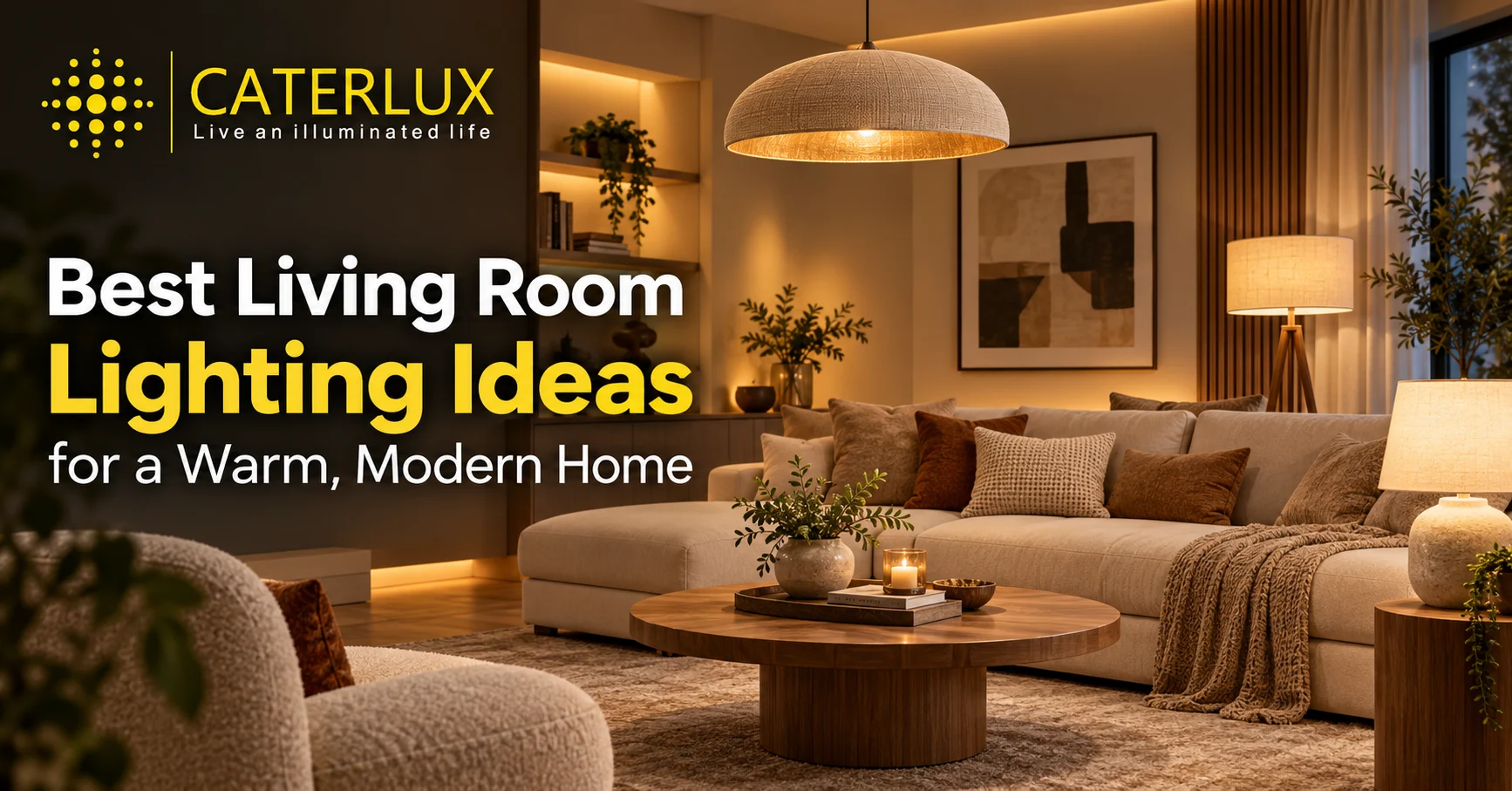
Best Living Room Lighting Ideas for a Warm, Modern Home
The best living room lighting ideas share one quality: they account for the fact that a living room does multiple things. It’s a space for conversation, for television, for reading, for entertaining, and sometimes for doing nothing in particular. Lighting that works for one of these often works against the others when the setup is too simple.
Modern living room lighting has moved past the single ceiling fixture. The homes that feel most comfortable and considered use living room lighting layout with multiple sources — ambient lighting for living room at low intensity, directed accent for features and art, task lighting near seating, and indirect lighting that adds depth without adding glare. Caterlux designs architectural LED lighting for exactly this kind of layered approach — their range includes cove lighting systems, magnetic track fixtures, LED downlights, Best LED Panel Light, and wall-wash solutions that give living rooms the kind of flexibility that a fixed single source never will. This guide covers the best living room lighting ideas for spaces of different sizes and uses, and how to execute them.
What to Consider Before Planning Living Room Lighting
Before choosing any fixture, map the room’s functions and existing conditions.
How is the room used? Television watching has different lighting requirements from dinner conversation. A room that hosts both needs circuits that can shift between modes.
Where does natural light enter? Morning sun from the east, afternoon sun from the west. Artificial lighting supplements what the room gets naturally — its position and intensity should account for the natural light’s direction.
What’s the ceiling height? Low ceilings (below 2.7m) benefit from flush or recessed fixtures. Higher ceilings allow pendants, chandeliers, and cove detailing without the room feeling closed in.
What surfaces matter visually? A textured feature wall, artwork, or architectural element worth illuminating changes the accent lighting plan. Knowing this upfront avoids retro-fitting later.
3 Types of Living Room Lighting
Ambient lighting — the base layer. Provides general illumination that makes the room usable without other sources active. False ceiling lighting for living room applications, cove lighting, and broad-distribution LED downlights all work as ambient sources. The goal is even light with no harsh shadows.
Task lighting — directed light for specific activities. A floor lamp near the reading chair, a table lamp beside the sofa, or track lighting over a work surface. Task lighting should be independent of the ambient circuit so it can be active at full brightness while ambient is dimmed.
Accent lighting — used to highlight. Artwork, architectural elements, plants, and feature walls are the typical subjects. LED spotlights, wall washers, and directional track fixtures produce the directional light that accent requires.
Best Living Room Lighting Ideas
Cove lighting living room — LED strip concealed in a ceiling recess or cornice detail that throws light upward onto the ceiling plane. Creates depth and warmth without any visible fitting. One of the most consistently effective ambient lighting choices for living rooms. The ceiling becomes the light source, which removes the harsh downward glare of direct fittings.
Recessed downlights in a grid pattern — LED downlights set into a false ceiling, distributed evenly across the floor plan. Works as ambient when the full grid is active; creating zones by activating only selected circuits gives flexibility for different uses.
Magnetic track lighting — a track system where fixtures attach magnetically and can be repositioned as furniture layouts change. Ideal for accent functions — redirecting a spot from one piece of art to another without electrical work. Caterlux’s magnetic track system is specifically designed for this flexibility.
Indirect lighting living room — LED profiles behind furniture, inside alcoves, or beneath floating shelving units. Light that doesn’t have a visible source creates atmosphere and visual depth that direct fittings can’t replicate.
Living room chandelier ideas — a pendant or chandelier over the central seating area works as both ambient source and design focal point. Scale matters: a chandelier that’s too small for the ceiling height reads as tentative. Match the fixture diameter (in cm) roughly to the room’s diagonal measurement (in metres).
Living room wall lights — sconces on either side of a feature wall, flanking a fireplace, or on the wall behind a sofa add warmth at eye level. Wall lights work particularly well in combination with cove lighting — one layer works the ceiling, the other works the lower walls.
Read more: Profile Light for Kitchen: Why Your Kitchen Deserves Better Lighting
Living Room Lighting Ideas for Different Spaces
Small Living Room
Lighting for small living room spaces should feel generous rather than cramped. The mistake most people make is reducing the number of sources — which makes the room feel more constrained, not less.
Instead: use recessed lighting flush with the ceiling (avoids the visual weight of pendant fixtures), add living room wall lights to push light across the lower half of the room, and use a cove or indirect layer to illuminate the ceiling — which visually raises the apparent height. Avoiding large pendant fixtures is about clearance, not about having fewer light sources.
Large Living Room
Layered lighting is most important in large living rooms because a single overhead source leaves the perimeter dark and creates an uneven experience. The best living room lighting ideas for larger spaces use multiple circuit zones:
A perimeter cove for ambient, a central track or downlight grid for general illumination, accent fixtures on art and features, and task sources near each seating cluster. Each zone should be on an independent dimmer.
TV and Entertainment Area
The area around a television needs careful treatment. Bright ambient light behind the screen creates contrast that strains the eyes during extended viewing. The best living room lighting ideas for TV areas use indirect or bias lighting — LED strip behind the television or panel, soft ambient from a cove, and little or no direct downlight aimed at the viewing position.
Colour temperature matters here: 2700K (warm white) reduces the harsh contrast between a bright screen and a dark surrounding room.
Reading or Seating Area
A reading chair or sofa position needs a dedicated task source — not just ambient light from the ceiling. Floor lamps positioned beside or behind the seating position provide light that falls on the reading surface without producing glare or eye strain.
Wall-mounted reading lights (adjustable arm or fixed directional) are the more permanent solution — they free up floor space and can be directed precisely at the book or screen.
How to Create a Living Room Lighting Layout
A practical living room lighting layout takes about thirty minutes with a floor plan.
Mark the room’s functions. Television position, primary seating, reading positions, dining area if it shares the space.
Assign ambient sources first. Where will the base illumination come from? Cove position, downlight grid, or a combination. Mark the circuit areas.
Add task sources. Each seating and reading position needs a dedicated source. Mark these as separate points.
Add accent positions. Which walls or features will be lit? Mark the fixture positions for these.
Plan circuits. Group ambient, task, and accent on separate dimmers. This is the most important execution detail — without independent control, the layers can’t be balanced for different uses.
Check for shadow sources. Walk through the floor plan and identify any position where a person would be standing between a light source and a work surface. Reposition sources to eliminate task shadows.
Tips for a Warm and Modern Living Room
Stay between 2700K and 3000K. Warm white colour temperature is what produces the evening warmth that living rooms should feel. Cooler temperatures — 4000K and above — are for task-heavy spaces like kitchens and offices. A living room at 4000K feels like a showroom.
Dim everything. Full brightness is appropriate for about 20% of the time a living room is used. The other 80% benefits from lower, warmer light. Dimmer switches on every circuit are not optional for a well-lit living room.
Match fixture finishes. Mixing brushed gold, chrome, and matte black in one room fragments the visual language. Pick one finish and apply it across all visible hardware.
Don’t over-light the TV wall. Bright downlights aimed at a television wall create glare that undermines the viewing experience. Soft indirect or bias lighting is the right treatment for this surface.
Consider smart control. Setting up scenes — “movie mode,” “evening,” “full bright” — through a smart lighting system means the right atmosphere for each activity is one tap away rather than a manual process of adjusting multiple dimmers.
Conclusion
The best living room lighting ideas aren’t about choosing the most impressive fixture. They’re about building a layered lighting plan where ambient, task, and accent sources work together and can be controlled independently for different uses.
Caterlux’s living room lighting range — cove and profile systems, magnetic track fixtures, recessed LED downlights, and wall washers — provides the architectural-grade tools to execute this properly. Explore the full collection at caterlux.in.
FAQs
- What are the best living room lighting ideas?
Layer ambient, task, and accent lighting using cove lights, downlights, wall lights, and focused fixtures for flexibility. - What type of lighting is best for a living room?
A combination of ambient, task, and accent lighting creates balanced illumination for different activities and moods. - What is the best lighting for a small living room?
Use recessed ceiling lights, wall lights, and indirect or cove lighting to make the space feel brighter and more open. - What colour temperature is best for living room lighting?
Warm white lighting between 2700K and 3000K creates a comfortable and relaxing atmosphere for living rooms. - How should I plan a living room lighting layout?
Start with ambient lighting, then add task and accent sources, keeping each layer on separate circuits or dimmers.