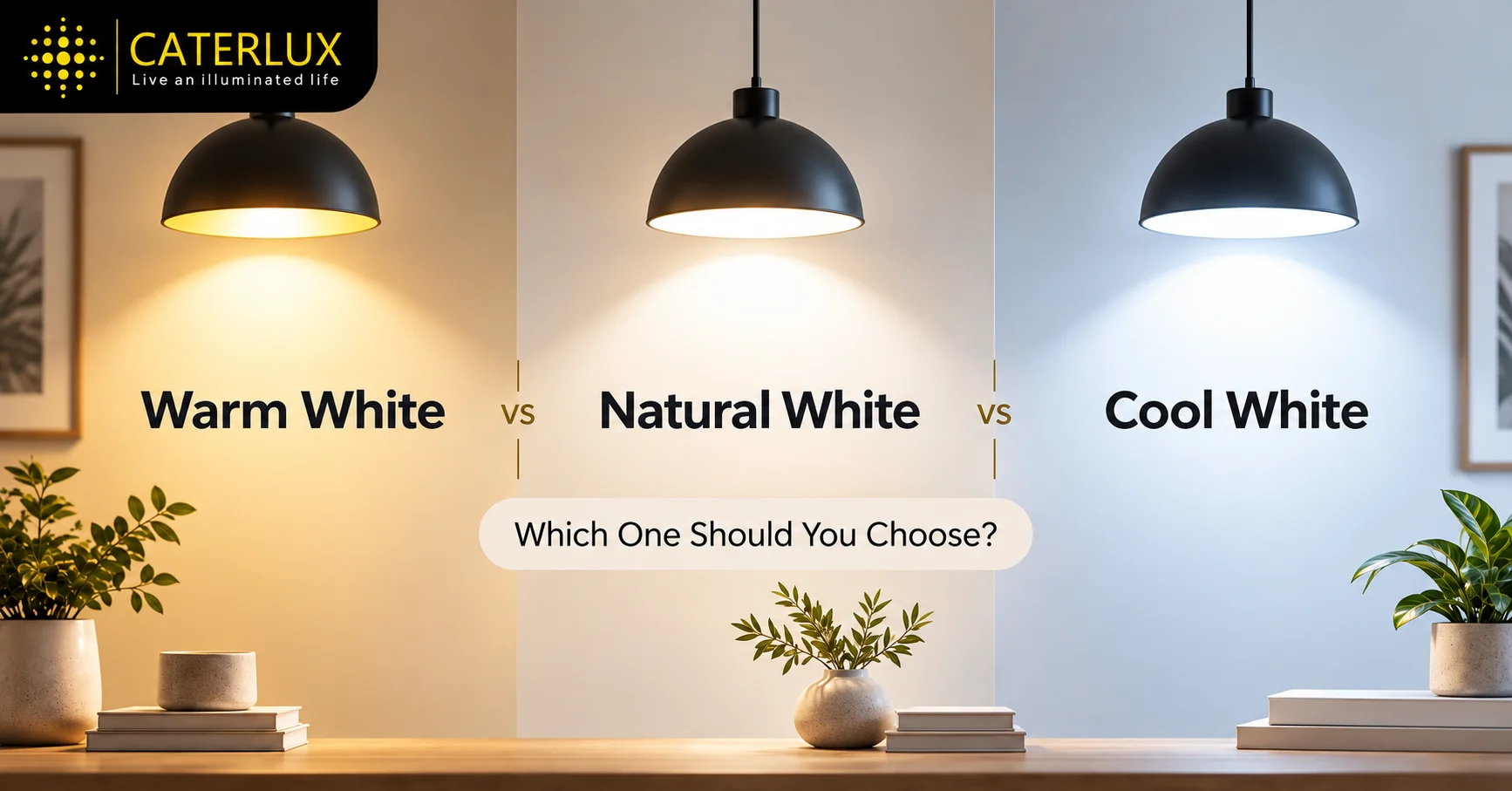
Warm White vs Natural White vs Cool White LED Lights: Which One Should You Choose?
If you’ve ever bought an LED bulb based purely on wattage and come home to a light that made your kitchen feel like a hospital corridor or your living room look like a dim café, you’ve experienced the colour temperature problem firsthand. LED colour temperature — measured in Kelvin — determines the quality of light far more than wattage does. Natural white light sits at the middle of the scale, and for many homes and offices it’s the most balanced option available. But the right choice depends on the room, the activity, and what you want the light to do.
This guide covers all three: warm white, natural white LED light, and cool white. By the end, you’ll know which suits each room in your home or office — and why the difference matters more than most people expect.
Caterlux manufactures LED bulbs and fixtures across all three colour temperature ranges, with consistent Kelvin output and CRI 90+ specifications for home, commercial, and hospitality applications.
What Is Colour Temperature in LED Lights?
Colour temperature is a measurement — in Kelvin (K) — of how warm or cool a light appears. The scale runs from roughly 1,800K (candlelight) up to 6,500K (overcast daylight). The LED light colour — its hue — is what Kelvin measures. It has nothing to do with brightness.
Lower Kelvin = warmer, yellower light. Think candlelight, incandescent bulbs, sunset. This is warm white light in its most recognisable form. Higher Kelvin = cooler, bluer light. Think daylight, fluorescent tubes, overcast sky.
The three main LED categories used in residential and commercial applications in India:
- Warm White: 2700–3000K
- Natural White: 3500–4000K
- Cool White: 5000–6500K
Understanding which of these is the right LED bulb colour temperature for a space is the most practical decision most homeowners make for LED lighting for home or office.
Warm White LED Light: 2700–3000K
Warm white produces a soft, yellowish glow — the quality closest to an old incandescent bulb. At 2700K, it’s almost amber; at 3000K, it’s warmer than natural but not heavily tinted.
Where it works: Bedrooms, living rooms, dining rooms, hotel lobbies, and any space where relaxation is the goal. The 3000K LED light triggers the body’s wind-down response — warm light in the evening is associated with lower stress and easier sleep transitions.
Where it doesn’t work: Kitchens and bathrooms where task accuracy matters. Food preparation under warm white looks different — colours shift toward yellow, which makes whites look cream and greens look dull. Fine detail work like shaving or applying makeup is also harder under warm light.
Best LED light for bedroom: 2700–3000K warm white. Every time.
Natural White LED Light: 3500–4000K
Natural white light sits between warm and cool — close enough to daylight that the eye reads it as neutral. A 4000K LED light is what most people think of as “white” light without any noticeable colour cast.
This is the most versatile colour temperature range. This light works in kitchens without making the space feel clinical. It works in living rooms without the heaviness of warm light. It’s the standard specification for office lighting where task performance and visual comfort need to coexist.
Natural white light is particularly effective in spaces that serve multiple purposes through the day — a home office that’s also a spare bedroom, a kitchen that’s also an eating area. The neutrality means it reads well under both bright and dimmer conditions.
Where it works: Kitchens, bathrooms, home offices, study rooms, retail spaces, restaurant service areas, and any multi-purpose room.
Best LED light for kitchen: 3500–4000K. Best LED light for office: 4000K — natural white light at its most practical.
Read more: LED Profile Light Price in India: Complete Cost Guide for Ceiling Profile Lights
Cool White LED Light: 5000–6500K
Cool white light has a blue-white quality that mimics overcast daylight. A 5000K LED light or 6500K LED light is the closest to pure daylight available in an artificial source.
The 5000K LED light and above promote alertness, which makes it effective in working environments where sustained concentration is needed. Factories, hospitals, supermarkets, and commercial warehouses typically specify cool white.
In residential use, cool white is less comfortable for extended periods — the blue component suppresses melatonin production and can make evenings in bright cool light feel disruptive to sleep. Used selectively in work areas, garages, or task-specific zones, it’s effective. Used as general ambient lighting throughout a home, most people find it harsh.
Where it works: Workshops, commercial spaces, hospitals, retail product displays, and task-specific residential zones like garages.
Warm White vs Natural White
The most common comparison for residential buyers is between warm and natural. The practical difference:
Warm white (2700–3000K) makes spaces feel cosy and relaxed. Skin tones look warmer. Wood and warm-coloured materials look richer. It’s flattering for people but not ideal for detailed work.
Natural white light (3500–4000K) reads as neutral. Materials look closer to their actual colour. It’s better for tasks and more versatile across different times of day. Spaces with neutral or cool colour palettes — white walls, grey tones, modern interiors — look better under natural white than warm.
Choose warm white for: bedrooms, living rooms, intimate dining. Choose natural white light for: kitchens, bathrooms, studies, multi-use spaces.
Cool White vs Natural White
Cool white vs natural white comes down to how much you want the light to resemble daylight.
Natural white light (3500–4000K) is near daylight without the blue shift that makes cool white feel clinical indoors. For most home and office applications, natural white LED delivers the daylight quality people want — clarity, colour accuracy, visual alertness — without the harshness of the top end of the Kelvin scale.
Cool white (5000–6500K) is appropriate when maximum alertness and the closest approximation to outdoor daylight is the goal. Commercial retail sometimes uses 5000K+ to make product colours appear vivid. For home use, 4000K is almost always the better call over cool white — the difference in clarity is modest; the difference in comfort over hours is significant.
Warm White vs Cool White
Warm white vs cool white represents the full range of the decision. The warm vs cool lighting debate in most homes has the same answer: neither extreme for every room — warm white in the living areas, natural white or cool white in task zones.
The functional principle: match the Kelvin temperature to what you want the room to do. Room-wise LED lighting decisions — made upfront rather than after installation — avoid the return-and-replace cycle most buyers want to skip. Sleep and relaxation — warm. Focus and task work — natural or cool white. Visual display and commercial application — cool.
Which LED Light Is Best for Each Room?
| Room | Recommended Kelvin | Colour Category |
| Bedroom | 2700–3000K | Warm White |
| Living Room | 2700–3000K | Warm White |
| Dining Room | 2700–3000K | Warm White |
| Kitchen | 3500–4000K | Natural White |
| Bathroom | 3500–4000K | Natural White |
| Study / Office | 4000K | Natural White |
| Garage / Workshop | 5000–6500K | Cool White |
| Retail / Commercial | 4000–5000K | Natural to Cool White |
How to Choose the Right Natural White LED Light
When specifying a natural white LED bulb for natural white light output, a few details matter beyond the Kelvin rating:
CRI (Colour Rendering Index): A 4000K natural white LED with CRI 80 and a 4000K LED with CRI 95 look different — the high-CRI version renders colours more accurately. For kitchens and workspaces where colour matters, CRI 90+ is worth specifying.
Dimmability: Not all LED bulbs are dimmable. If the fitting will be on a dimmer, confirm compatibility. A natural white LED bulb on a dimmer can shift warmer as intensity drops — a pleasant effect that mimics warm light in the evening.
Consistency across fittings: Buy enough bulbs from the same production batch for a room. Natural white LEDs from different brands or batches can vary enough in Kelvin output to be visibly mismatched when installed side by side.
How Light Shades Affect LED Colour
The shade or diffuser over an LED source affects the perceived colour temperature. Amber or warm-toned shades shift a cool or neutral LED warmer. Frosted white shades reduce the colour shift and output a softer version of the source colour. Opaque shades can significantly reduce the effective Kelvin reaching the room.
This matters when choosing a natural light LED for a decorative fitting with a warm-toned shade — you may need to go slightly cooler (4000K) to compensate for the shade’s warming effect and achieve the 3500–3800K quality you want in the room.
Quick Comparison: Warm vs Natural vs Cool White
| Feature | Warm White (2700–3000K) | Natural White (3500–4000K) | Cool White (5000–6500K) |
| Appearance | Yellowish, soft | Neutral, balanced | Blue-white, crisp |
| Mood effect | Relaxing, cosy | Neutral, versatile | Alerting, energising |
| Task suitability | Low | High | High |
| Skin tone rendering | Flattering | Natural | Clinical |
| Best residential use | Bedroom, living room | Kitchen, bathroom, study | Garage, workshop |
| Best commercial use | Hospitality, restaurants | Offices, retail | Industrial, medical |
Conclusion
The warm white vs natural white vs cool white decision has a practical answer for every room: match the Kelvin temperature to the activity the room is designed for. Natural white light at 3500–4000K is the most versatile choice — suited to most task-oriented and multi-use spaces. It’s the natural white light specification that comes up most often in both home and commercial projects for good reason.
For residential buyers who want the flexibility of all three, Caterlux LED bulbs are available across the full Kelvin range with consistent CRI 90+ output. Visit caterlux.in for product specifications and room-wise recommendations.
FAQs
- What is natural white light?
Natural white light usually ranges from 3500K to 4000K and gives a balanced, neutral appearance without looking too yellow or blue. - Is natural white better than warm white?
Natural white is better for kitchens, bathrooms, and offices, while warm white works better for bedrooms, living rooms, and relaxing spaces. - What is the difference between cool white and natural white?
Natural white is softer and more balanced, while cool white has a stronger blue-white appearance and feels brighter and more alert. - Which LED light is best for a bedroom?
Warm white LED light between 2700K and 3000K is generally best for bedrooms because it creates a soft and relaxing atmosphere. - Which LED light is best for a kitchen?
Natural white LED light between 3500K and 4000K is a good choice for kitchens because it provides clear and balanced lighting.