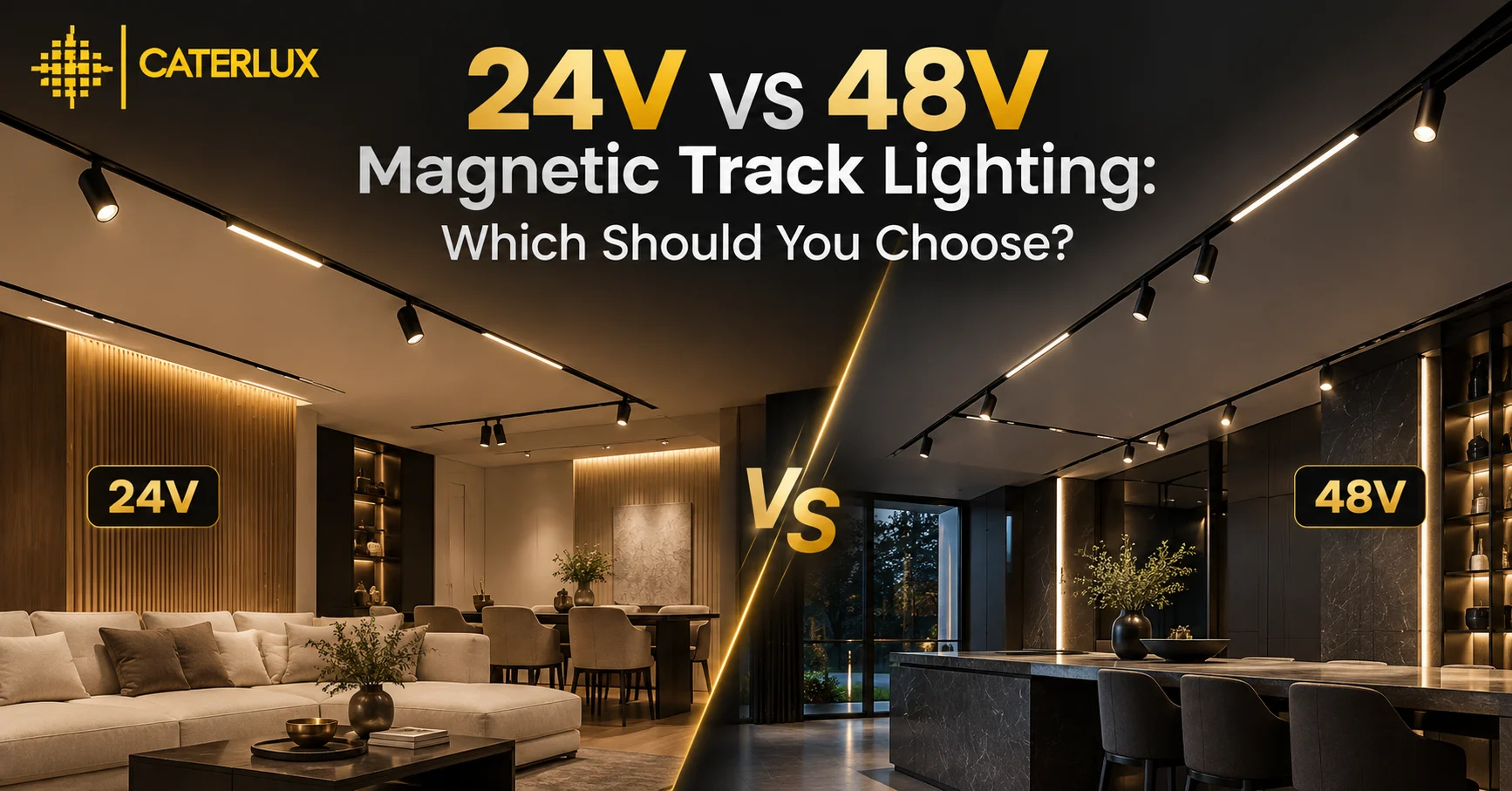
24V vs 48V Magnetic Track Lighting: Which Should You Choose?
The 24V vs 48V magnetic track lighting question comes up in almost every project where magnetic track is being specified — and it’s not a trivial one. The voltage affects what fixtures you can run, how long the track can extend without a driver, how the system handles dimming, and ultimately what the installation costs. Getting this wrong means either under-specifying for the application or spending more than necessary.
Caterlux manufactures magnetic track lighting systems for residential, commercial, and hospitality projects across India. Their range covers both voltage standards with architectural-grade fixture quality — and understanding the difference between the two is what this guide covers, in practical terms rather than technical abstraction.
What Is Magnetic Track Lighting?
Magnetic track lighting is a low-voltage linear lighting system where individual fixtures attach to a recessed or surface-mounted track using magnetic connection rather than mechanical clips or tools. The track carries the low-voltage DC current; the fixture makes electrical contact simply by being pressed against the track.
The mechanism has two practical advantages over conventional track lighting. First, fixtures can be repositioned along the track without tools or electrical work. Second, the installation accommodates a wide range of fixture types — spotlights, pendant drops, wall washers, linear modules — on the same track without changing connectors.
The track itself is typically recessed flush with the ceiling, making the system nearly invisible when no fixture is attached. The visible elements are only the fixtures.
24V Magnetic Track Lighting
24V magnetic track systems operate at 24 volts DC. This is the lower voltage standard and the more common specification in residential and smaller commercial projects.
Advantages:
- Wider fixture compatibility — more manufacturers produce 24V magnetic track fixtures
- Lower equipment cost — 24V drivers and components are more widely available and typically cheaper
- Safety — 24 volts is a SELV (Safety Extra-Low Voltage) level, well below the 50V AC threshold that requires additional safety measures
- Compatible with standard LED dimming protocols at short runs
Limitations:
- Track run length — 24V systems experience more voltage drop over longer distances. Practical maximum continuous run per driver is typically 5–8 metres before brightness variation becomes visible
- Lower maximum load — a single 24V driver circuit handles less total wattage than an equivalent 48V circuit
- Not suitable for high-output commercial applications where fixture wattage per metre is high
24V magnetic track lighting is the right choice for most residential living rooms idea, bedrooms, boutique retail, and hospitality spaces where the total run is under 6 metres and fixture density is moderate.
48V Magnetic Track Lighting
48V magnetic track systems operate at 48 volts DC. This is the higher voltage standard, increasingly specified in commercial, retail, and large residential applications.
Advantages:
- Longer track runs — voltage drop is significantly lower at 48V, allowing continuous runs of 15–20 metres from a single driver without visible brightness variation
- Higher wattage capacity — more fixtures and higher-wattage fixtures can be accommodated per circuit
- Better dimming performance over long runs — voltage stability across the track means dimming behaviour is consistent along the full length
- Suited to commercial retail and large open-plan spaces where run length and fixture density are higher
Limitations:
- Higher driver cost — 48V DALI or 0-10V compatible drivers cost more than 24V equivalents
- Fewer lower-cost fixture options — the 48V fixture ecosystem is smaller than 24V, though this is changing rapidly
48V magnetic track lighting is the right specification for commercial retail, restaurants, galleries, hotels, and any space where the track run exceeds 8 metres or where high-output fixtures (20W+ per unit) are needed for display or architectural applications.
24V vs 48V Magnetic Track: Key Differences
| Feature | 24V Magnetic Track | 48V Magnetic Track |
| Voltage | 24V DC | 48V DC |
| Typical max run length | 5–8 metres per driver | 15–20 metres per driver |
| Voltage drop | More pronounced on long runs | Minimal on standard runs |
| Fixture wattage range | 3W–15W typical | 5W–30W typical |
| Driver cost | Lower | Higher |
| Fixture availability | Wide | Growing |
| Best application | Residential, boutique retail | Commercial, large-scale retail, hospitality |
| Dimming consistency | Good on short runs | Consistent across full run length |
| Safety class | SELV | SELV (with appropriate drivers) |
24V vs 48V Magnetic Track Lighting: Which Is Better?
Neither is universally better — they’re designed for different scale requirements.
The 24V vs 48V magnetic track lighting decision should start with two questions: how long is the longest continuous track run in the project, and what wattage per fixture is needed?
Choose 24V if:
- Track runs are under 6 metres
- The project is residential or boutique commercial
- Budget for the driver is a factor
- Fixture wattage is in the 5–12W range
Choose 48V if:
- Any single track run exceeds 8 metres
- The space is commercial, retail, or hospitality with high-output fixture requirements
- Consistent dimming across the full track length is required
- The project involves large open-plan spaces with multiple fixtures per run
For most Indian residential projects — living rooms, dining areas, bedrooms — 24V is adequate and the lower driver cost is a meaningful saving. For restaurants, retail, hotels, and large commercial spaces, 48V is the appropriate specification.
Magnetic Track Light Price and Cost in India
Magnetic track light price in India varies by voltage, fixture type, brand quality, and whether the system is architectural grade or consumer grade.
Track (per metre):
- 24V surface/recessed track: ₹1,200 – ₹3,500 per metre
- 48V recessed track: ₹2,000 – ₹5,000 per metre
Drivers:
- 24V driver (60W–150W): ₹1,500 – ₹5,000
- 48V DALI driver (100W–200W): ₹4,000 – ₹10,000
Fixtures (per unit):
- 24V magnetic spotlight (5W–12W): ₹1,500 – ₹4,500
- 48V magnetic spotlight (10W–25W): ₹2,500 – ₹8,000
- Pendant drops, wall washers, linear modules: ₹3,000 – ₹15,000 depending on type
Magnetic track light cost per meter for a complete installed system (track, fixtures, driver, installation) typically runs ₹8,000–₹25,000 per metre for residential applications and ₹15,000–₹40,000 per metre for commercial, depending on fixture density and specification level.
Caterlux’s magnetic track range sits in the architectural-grade segment — their pricing reflects the optical quality, colour accuracy, and CRI performance that design-led projects require.
How to Choose the Right Magnetic Track Lighting System
Map your track runs first. Measure the longest continuous run in the project. If it exceeds 8 metres, start with 48V.
Count fixture positions. How many fixtures per metre, and at what wattage? Total wattage per run determines driver sizing.
Decide on dimming protocol. If the system integrates with smart home or building management, confirm the driver’s protocol (DALI, 0-10V, Triac) is compatible.
Choose fixture types for the application. A good magnetic track system isn’t just spotlights — it accommodates pendant modules for dining areas, wall washers for feature walls, and linear strips for cove effects on the same track infrastructure.
Specify from a magnetic track light manufacturer in India who provides photometric data. Beam angles, lumen output at distance, and colour rendering should be verifiable before purchase, not assumed from product images.
Conclusion
The 24V vs 48V magnetic track lighting decision comes down to scale and application. For residential and boutique spaces with shorter runs, 24V delivers everything needed at a lower system cost. For commercial and large-scale spaces where run length and fixture output matter, 48V is the correct specification.
For architectural-grade magnetic track lighting across both voltage standards, Caterlux designs and supplies systems for residential and commercial projects across India. Explore the full magnetic track range at caterlux.in.
FAQs
- What is magnetic track lighting?
Magnetic track lighting is a low-voltage lighting system where lights attach to a track with magnets. Fixtures can be moved, added or removed anytime without tools. - What are the types of magnetic track?
There are three main types of magnetic track: recessed, surface mounted and suspended. They are available in 24V and 48V versions. - What are the applications of magnetic track lighting?
Magnetic track lighting is used in homes, offices, retail showrooms, hotels, restaurants and galleries. It is ideal for flexible accent and ambient lighting. - Which is the best brand for magnetic lighting systems?
The best brand for magnetic lighting systems offers a complete range of tracks, drivers and fixtures, high CRI lights, reliable drivers and strong after-sales support. - What makes a top professional lighting brand?
A top professional lighting brand offers architectural-grade products, high light quality, certified components and project support from design to installation. - Which company is most experienced in magnetic track lighting?
The most experienced magnetic track company has years of industry presence, a large portfolio of completed projects and proven technical expertise. - What is the slimmest magnetic track?
The slimmest magnetic track is an ultra-slim track with a very narrow profile that blends seamlessly into the ceiling, ideal for minimal and modern interiors. - How to choose the best company for magnetic track?
Choose a company that offers a complete system, quality drivers, 24V and 48V options, warranty and installation support