Best LED Lights for Low Ceiling Heights: Ideas & Tips
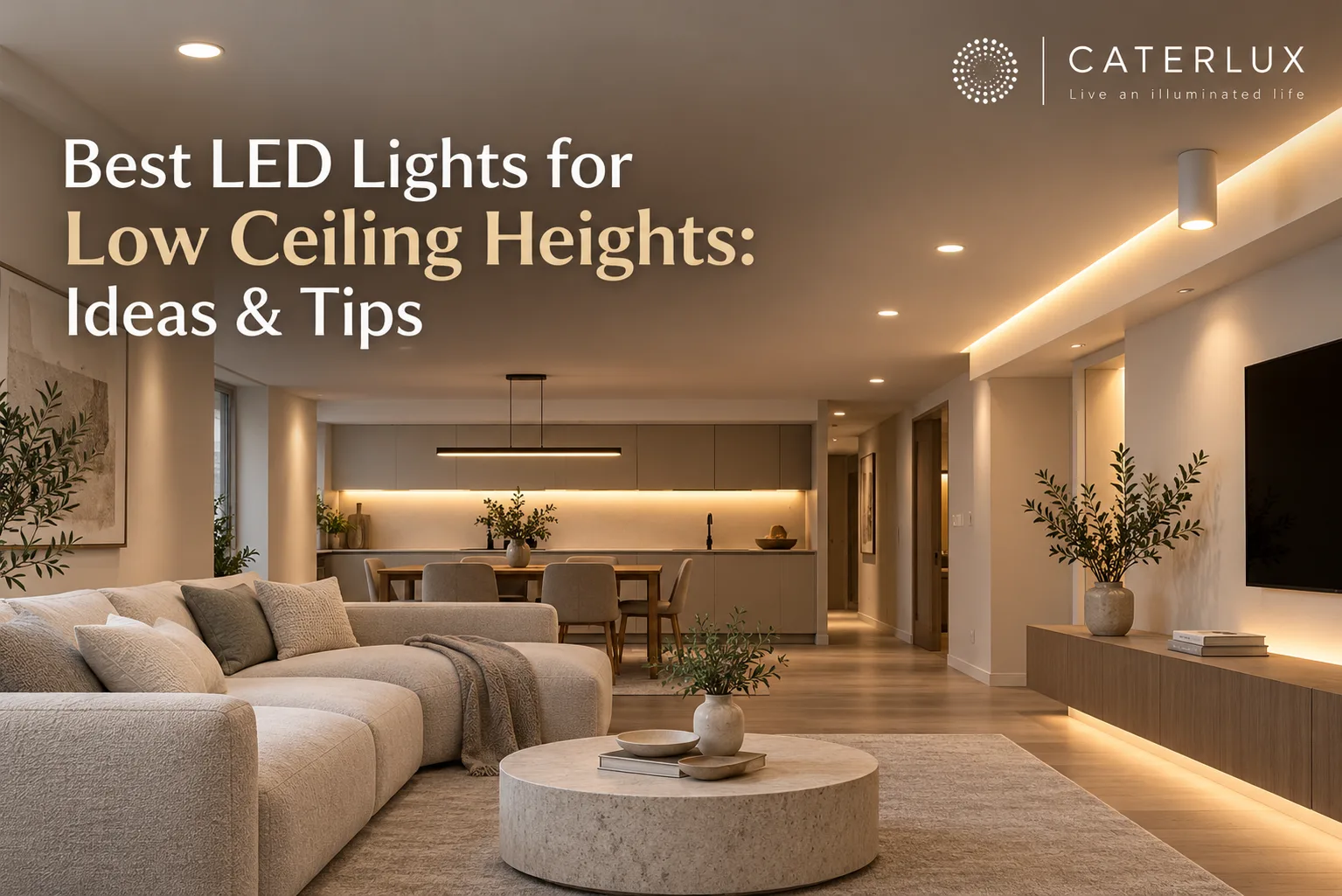
A low-ceiling room — anything under 8 feet — doesn’t have to feel cramped. The best lights for low ceiling rooms make that difference — between a space that feels tight and one that feels intentionally compact. LED lights for low ceilings solve the most common problem: standard pendant lights and chandeliers hang too far down, reducing headroom and making the ceiling feel even lower than it is.
Choosing the best lights for low ceiling rooms means selecting fixtures that sit close to the ceiling, distribute light efficiently, and don’t create glare. Caterlux manufactures LED ceiling fixtures and recessed downlights specifically suited to residential and commercial spaces with limited ceiling height — products that solve the light-without-bulk problem that plagues low-ceiling rooms.
Best Types of LED Lights for Low Ceilings
Flush mount fixtures — the most direct solution for LED lights for low ceilings. The fixture sits completely flat against the ceiling with no gap. Available in circular, square, and rectangular profiles, modern versions produce even, diffuse light without the dated look of older fluorescent batten lights.
Recessed LED lights for low ceilings — also called downlights or pot lights, these are installed inside the ceiling void with only the trim visible at the surface. They take up zero visible headroom, which is why they’re the preferred choice for false ceilings and dropped ceilings where the void exists to house them.
Surface-mounted LED lights — slightly raised from the ceiling surface but significantly lower profile than pendants or chandeliers. These surface-mounted LED lights are typically 30–50mm in total depth — practical where there’s no ceiling void for recessed installation.
LED strip lights — mounted in coves or above cabinetry. Slim LED ceiling lights and strip systems are the two most versatile options for LED ceiling lights for small rooms. Not a primary light source but effective as indirect ambient lighting where direct overhead light creates glare.
Low-profile ceiling lights — ultra-thin circular or panel designs projecting 20–30mm from the ceiling. Increasingly common in modern residential projects where minimalist ceiling lighting is part of the interior language — slim LED ceiling lights suit this aesthetic best.
Low Ceiling Lighting Ideas for Different Rooms
Living room: The best low ceiling lighting ideas for living rooms combine recessed downlights for ambient fill and LED strip cove lighting for atmosphere. Avoid single central fixtures — they create a pool of light in the middle and leave the edges dim. Distribute recessed downlights in a grid pattern, supplemented by floor lamps for warmth.
Bedroom: Flush mount LED ceiling lights at the centre and bedside wall sconces for reading. The ceiling fixture handles ambient light; the sconces handle task light. This avoids the need for table lamps that take up limited bedside space and eliminates harsh overhead light when you don’t need it.
Kitchen: Recessed downlights over the work surfaces and under-cabinet LED strips for task illumination. LED ceiling lights for small rooms like kitchens should prioritise uniform counter coverage without shadow zones. 4000K colour temperature works well here.
Bathroom: Flush mount or slim surface-mounted LED over the vanity, with an IP-rated recessed downlight over the shower zone. Avoid pendant lights in bathrooms with low ceilings — they restrict movement and create hazards.
Corridor: A linear run of recessed downlights at even intervals gives the corridor a designed look without reducing headroom — far better than a single central batten.
How to Choose the Right LED Ceiling Lights
Colour temperature. Bedrooms and living rooms: 2700–3000K. Kitchens and study rooms: 4000K.
Lumen output. 300–500 lumens per recessed downlight for ambient; 800–1200 for a primary flush mount in a standard bedroom.
Beam angle. A 60–90° spread for ambient downlights. Anti-glare LED lights use deeper trim rings to limit the visible source angle — important in rooms where the light is closer to eye level.
CRI. CRI 90 or above for living spaces and kitchens.
IP rating. IP44 minimum for bathrooms and kitchens. IP65 for shower zones.
Flush-Mount vs Recessed LED Lights
| Factor | Flush Mount LED Ceiling Lights | Recessed LED Lights for Low Ceilings |
| Ceiling void required | No | Yes (usually 80–120mm) |
| Visible profile | Minimal | None |
| Light distribution | Wide, diffuse | Directional or semi-spread |
| Installation | Simple | Requires cutting into ceiling |
| Best for | Rooms without false ceiling | False or dropped ceilings |
| Replaceability | Easy | Access from below |
In rooms without a ceiling void, flush mount or low-profile ceiling lights are the only practical options. Where a false ceiling exists, recessed downlights are almost always the better choice.
False Ceiling Lighting Ideas for Low Heights
A false ceiling in a low-height room needs to be designed to add light, not reduce headroom. False ceiling lighting ideas that work in constrained heights:
Peripheral cove lighting. LED strips installed in a recessed channel around the ceiling perimeter, angled to wash light upward. This creates the visual effect of the ceiling lifting — the indirect glow makes the space feel more open than direct overhead light does.
Shallow recessed grid. A false ceiling at 6–8 inches below the original height, with recessed LED downlights flush with its surface. The false ceiling handles the lighting infrastructure; the room retains workable headroom.
Slot lighting. Narrow linear LED fittings in a slot cut into the false ceiling — works particularly well in corridors and narrow rooms.
Common Lighting Mistakes to Avoid
Using a single central ceiling fixture. One light source creates strong shadows on the edges of a room and makes the space feel less balanced. Multiple smaller fixtures always produce better results in low-ceiling rooms.
Hanging pendants where clearance is insufficient. A pendant in a 7-foot room leaves minimal headroom. The minimum clearance over a dining table is 180–200cm above the floor — often not achievable without a custom short-drop cord.
Ignoring glare. In a low-ceiling room, the light source is closer to eye level than in a room with standard height. Anti-glare LED lights with proper shielding or diffusion become more important, not less.
Choosing high colour temperature throughout. Cool white (5000–6500K) in a living room or bedroom creates a clinical feel that no amount of warm-coloured furnishing fully counteracts. Ambient lighting for small spaces generally works better at 2700–3000K.
Under-lighting. Thinking a single flush mount is sufficient for a 200 sq ft living area. It isn’t. Layer the light — ceiling, wall, and accent — and the room feels significantly larger.
Caterlux supplies LED ceiling fixtures, recessed downlights, and LED strip systems for residential and commercial applications — products specified for low-profile installation where ceiling height is a constraint. Visit caterlux.in for product specifications.
Conclusion
LED lights for low ceilings work best when the fixture choice matches the ceiling structure, the colour temperature suits the room function, and the light is distributed rather than concentrated in one point. Flush mount LED ceiling lights for rooms without false ceilings; recessed downlights where a void exists; and cove or strip lighting for atmosphere that makes the ceiling feel further away than it is.
The goal isn’t to fight the ceiling height — it’s to light the room so that height stops being the thing you notice.
FAQs
1. What are the best LED lights for low ceiling rooms?
Flush mount LED ceiling lights, recessed downlights, and slim surface-mounted fixtures are ideal for low ceilings because they provide light without taking up much headroom.
2. Are flush mount or recessed LED lights better for low ceilings?
Flush mount lights suit rooms without a ceiling void, while recessed LED lights work best in false ceilings with enough installation space.
3. What colour temperature is best for low ceiling rooms?
Warm white light between 2700K and 3000K works well for bedrooms and living rooms, while 4000K is suitable for kitchens and study rooms.
4. How can I make a low-ceiling room look bigger with lighting?
Use multiple light sources, indirect cove lighting, and evenly distributed downlights to reduce harsh shadows and make the room feel more spacious.
5. Can I install recessed LED lights in a low ceiling without a false ceiling?
Recessed lights generally require a ceiling void for installation, so flush mount or slim surface-mounted LED lights are more practical when space is limite