BIS Certified LED Lights: What Indian Buyers Should Check
The spec sheet says “BIS approved” in neat blue letters, and that is about all it says. BIS certified LED lights are supposed to come with proof, yet a logo pasted onto a PDF only proves that somebody owns a copy of the logo. A printed mark is a claim. Nothing more. The actual proof lives in a registration database, and honestly, almost nobody bothers to open it.
Then come the searches. Usually two. The first reads “is BIS mandatory for LED lights,” and the second asks what the mark should actually look like on a box. Fair enough. The trouble is that nearly every guide on BIS certification for LED lights is written for factories filing an application, not for the architect, contractor or purchase manager holding the invoice.
Stick around. By the end, you will know how to check BIS certification on any LED product in about five minutes, using three things: the label, the BIS CARE app and the supplier’s grant letter.
WHY BIS CERTIFIED LED LIGHTS MATTER
IS BIS MANDATORY FOR LED LIGHTS?
Yes, for notified categories. LED lamps, LED luminaires and the control gear that drives them all sit under CRS, which traces back to MeitY’s 2012 order for electronics and IT goods. If a product falls in a notified category, it cannot be made, imported, stocked or sold in India without registration. Simple as that.
BIS CRS REGISTRATION IN BRIEF
CRS runs on Scheme-II. Sounds technical. It isn’t, really. A maker picks one lead model and ships it off to a BIS-recognised lab. The lab tests it against the right IS. Report comes back clean? BIS hands over a registration with an R-number. Done. No ISI-style factory licence. Nobody from BIS camped outside the gate, either. The grant letters even call it an SDoC registration. Translation: the maker vouches for the product, in writing, under its own name.
WHO CARRIES THE LEGAL RISK
This is the part dealers like to skip. Section 17 of the BIS Act covers selling, storing and distributing, along with manufacturing. So the shop that stocks unregistered fittings and the contractor who installs them carry risk too. The factory does not take the fall alone.
What a contravention can cost:
- A fine of at least ₹2 lakh for a first contravention
- Do it again, and it’s ₹5 lakh minimum. Could climb to ten times what the goods are worth
- Jail time, up to two years
- It’s a cognizable offence. Police don’t need a warrant
Checking on your phone costs nothing. A lawyer costs plenty. So run a quick BIS registration number check before a single fitting hits the shelf. Or the ceiling.
LED LUMINAIRE BIS STANDARD MAP
LAMPS VS LUMINAIRES
Bulbs and fixtures do not share a rulebook. Bulbs go by IS 16102 (Part 1). Self-ballasted ones, to be exact. Fixtures are a whole other story. Downlights, track spots, panels, flood lights, they all land somewhere in the IS 10322 (Part 5) sections. And on most projects, you’re buying fixtures. Not bulbs. So say a downlight sold as one of your BIS certified LED lights has a bulb standard on its spec sheet. That’s wrong. Call the supplier. Small detail. Big tell.
| Product type | IS code |
|---|---|
| LED control gear (drivers) | IS 15885 (Part 2/Sec 13) |
| Self-ballasted LED lamps (bulbs) | IS 16102 (Part 1) |
| Fixed general-purpose luminaires | IS 10322 (Part 5/Sec 1) |
| Recessed luminaires | IS 10322 (Part 5/Sec 2) |
| Road and street lighting luminaires | IS 10322 (Part 5/Sec 3) |
| Portable general-purpose luminaires | IS 10322 (Part 5/Sec 4) |
| Flood lights | IS 10322 (Part 5/Sec 5) |
| Hand lamps | IS 10322 (Part 5/Sec 6) |
| Lighting chains | IS 10322 (Part 5/Sec 7) |
| Emergency lighting luminaires | IS 10322 (Part 5/Sec 8) |
THE DRIVER GAP
Magnetic track systems and linear profiles usually run on external drivers. Here’s the catch. The driver gets its own BIS CRS registration, under IS 15885. Fine. But that number belongs to the driver. Only the driver. The fixture hanging off it? Zero cover. Each piece needs its own registration, its own R-number, its own paperwork. Hardly anyone writing on this subject mentions it, which is exactly why it slips through on site.
THE 2026 REVISION CLOCK
The standards were revised this year, and then the deadline moved. BIS put out a corrigendum. Old cut-off: 02 August 2026. New one: 02 February 2027. Funny thing is, loads of top-ranking pages on BIS certification for LED lights never got the memo. Still saying August. So yeah, raise an eyebrow. The older 2012-era versions are still valid. For now. Only until this overlap runs out.
Here’s the move. Look at the IS year on the label. Note it down. Then verify the BIS R-number online and see which version it’s really registered under. They don’t always line up. Got a project handing over after February 2027? Get the supplier to spell out, in writing, how they’re switching over. And when.
ISI MARK ON LED LIGHTS: A MIX-UP
Plenty of people go hunting for lists of BIS approved LED brands in India. Then they glance at the logo. And stop. Familiar symbol, done deal. That habit is precisely how mislabelled stock slips into warehouses and up onto ceilings.
WHAT THE REAL MARK SHOWS
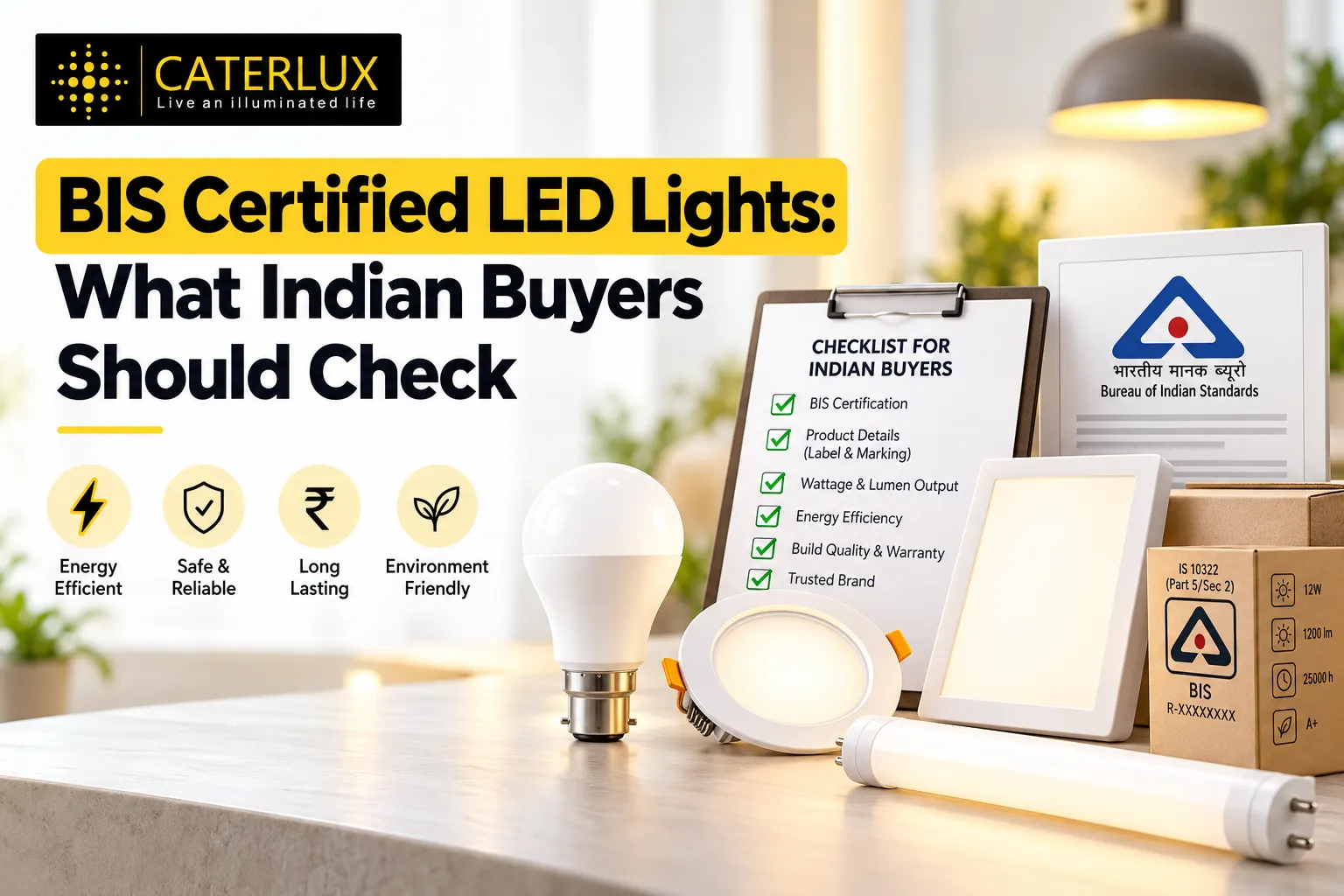
BIS certified LED lights under CRS carry the Standard Mark with an IS number and an R-number. They do not carry the ISI mark with a licence number, which belongs to Scheme-I products. For CRS-registered LED products, the R-number is the identifier that counts. The rest is decoration.
FIVE LABEL DETAILS TO READ
- The Standard Mark monogram.
- The IS code, along with its year.
- The R-number. In the grant letters we reviewed, it reads “R-” followed by eight digits.
- The IS number, registration number and wording, printed no smaller than Arial size 6.
- The mark itself, shown on the product and/or its packaging where it is easy to spot.
One last glance before you sign off: the IS code has to suit the product type. An LED luminaire BIS standard belongs on a luminaire, and a lamp standard belongs on a lamp.
HOW TO CHECK BIS CERTIFICATION
VERIFY BIS R-NUMBER ONLINE
The BIS CARE app has a dedicated function called “Verify R-Number under CRS.” Type in the number and the registration details show up within seconds. On a desktop, the registered manufacturers list on crsbis.in does the same job, with a bigger screen and fewer typos.
MATCH SIX DATA POINTS
Finding the number is step one. Matching it is where the real work happens. Hold these six details up against the product in front of you:
- Manufacturer name
- Factory address
- Brand
- Model number
- IS code with year
- Validity status
A BIS registration number check that skips the model number is only half a check. The number can be perfectly genuine and still belong to a different product.
SCAN THE GRANT LETTER QR
BIS grant letters carry a QR code. Scan it. That’s how you know the letter is real. Why bother? Suppliers love sending PDFs on WhatsApp, and PDFs are easy to tweak. One scan, and a fake BIS certificate LED sellers doctored before forwarding falls apart on the spot. Models added later come in separate inclusion letters. Ask for those too.
An LED product earns the order only after every check says yes
- Read the label
- Note the R-number and IS code
- Enter it in the BIS CARE app
- Registration found?
- Manufacturer and factory match?
- Model listed in grant or inclusion letter?
- Status valid?
- IS year current?
If “no” to any question (steps 4-8): Stop and report through the BIS CARE app.
If “yes” to all questions: Buy.
Every check has to come back yes. One “no” anywhere in the chain ends the purchase, and the app is the place to report it.
RED FLAGS OF FAKE COMPLIANCE
BORROWED R-NUMBERS
The number is real. It just belongs to another maker or another category altogether, like a driver’s number printed on a luminaire. Classic move. Probably the most common trick behind any fake BIS certificate LED buyers fall for. Why does it work so well? Someone searches the number, sees “valid,” and calls it a day.
MISSING MODEL NUMBERS
A registration covers the lead model plus the series models listed with it. Nothing more. If the model on your order is missing from the grant or inclusion letter, it is not covered, however similar it looks.
LAPSED VALIDITY
Registrations come up for renewal, and BIS issues renewal letters when they do. So a number that passed last year? Might be dead now. Nobody sends you an alert. Verify the BIS R-number online again right before you buy. Not once at tender stage and then never again.
WRONG MARK OR CODE
An ISI mark on LED lights registered under CRS is a mismatch. So is a bulb standard printed on a fixture, where the correct LED luminaire BIS standard should sit. Either slip usually means the label was designed by someone who never read the rules.
Spotted one of these? The BIS CARE app accepts complaints about misuse of the Registration (CRS) Mark. Two minutes of reporting can spare the next buyer a whole lot of grief.
BIS APPROVED LED BRANDS IN INDIA: MYTH VS REALITY
FACTORY, NOT BRAND
Quick reality check. BIS doesn’t publish any list of approved brands. None. The registration behind BIS certified LED lights is tied to four things. The manufacturer. The factory. The product category. The listed models. Brand name isn’t on that list. Move the machinery out of the registered premises, and the number can’t be used anymore. BIS has to be told, too. Also worth knowing: one brand might hold several R-numbers. Look each one up, and you’ll see which factory is really making that white-label product. Sometimes it’s a surprise.
FIVE QUESTIONS FOR SUPPLIERS
- Can you share the grant letter and the latest inclusion letter?
- Which IS year are you registered under?
- Does the driver have its own BIS CRS registration?
- Is the registration renewed, or close to lapsing?
- Will the R-number show up on your datasheets and invoices?
If a supplier goes quiet on any of these, pay attention. Confident sellers answer fast. The ones who dodge are often the ones holding a fake BIS certificate LED buyers later wish they had questioned.
CATERLUX: ONE PARTNER, EVERY LIGHT
Caterlux is a Delhi-based architectural lighting brand rooted in Make in India, and it would much rather you check than simply take its word. Pick any Caterlux product and run a BIS registration number check on it. That is the whole point of this guide, and BIS certified LED lights should hold up to that kind of scrutiny without flinching.
The range covers residential and commercial architectural lighting, from the Magnetic Lighting System, Exhibition Series, Pro Series and Acoustic Lighting Series to the Canon Zudo, Pattern and Pixel lines. You can download the catalogue, request a plan through the “Plan My Dream Interior Lighting” form, or reach the team on WhatsApp. Caterlux works through a partner network, turns up at events and exhibitions, and belongs to the DALI Alliance community for smart lighting. The blog runs practical buyer guides on CRI, colour temperature and 24V vs 48V track, written in the same spirit as this piece on BIS certification for LED lights. So instead of chasing lists of BIS approved LED brands in India, you get one partner for every lighting decision.
CONCLUSION
So, how to check BIS certification without losing an afternoon? Three moves. Read the label. Punch the number into the app. Then make sure the model on your order actually shows up on the grant letter. That’s it. Five minutes, maybe six if the Wi-Fi is acting up.
Quit hunting for an ISI mark on LED lights. It was never going to be there. Look for the R-number instead. And if someone still asks is BIS mandatory for LED lights, tell them yes, for every notified category. No wiggle room. Buy BIS certified LED lights with paperwork you’ve checked yourself. Oh, and 02 February 2027? Put it on a sticky note. Monitor, fridge, wherever. From that day on, it’s the new standards or nothing.
ACRONYMS USED
Full forms appear only in this section. The article body uses acronyms alone.
- BIS: Bureau of Indian Standards
- LED: Light Emitting Diode
- CRS: Compulsory Registration Scheme
- ISI: Indian Standards Institution
- IS: Indian Standard
- R-number: Registration Number
- SDoC: Self-Declaration of Conformity
- MeitY: Ministry of Electronics and Information Technology
- IT: Information Technology
- QR: Quick Response
- PDF: Portable Document Format
- CRI: Colour Rendering Index
- DALI: Digital Addressable Lighting Interface
FAQS
- Is BIS mandatory for LED lights sold in India?
Yes. Every notified LED product, from bulbs to drivers, needs BIS CRS registration before it can be sold, imported, or made.
- Should LED lights carry the ISI mark?
No. An ISI mark on LED lights is a red flag; look for the Standard Mark with an IS code and R-number instead.
- How do I verify a BIS R-number online?
Enter it under “Verify R-Number under CRS” in the BIS CARE app. That’s the quickest way for how to check BIS certification.
- How can I spot a fake BIS certificate LED sellers share?
The R-number is missing, can’t be found, or belongs to another brand or product. Scan the grant letter’s QR code to be sure.
- Is there an official list of BIS approved LED brands in India?
No. Registration covers a factory and specific models, so run a BIS registration number check on the exact product.