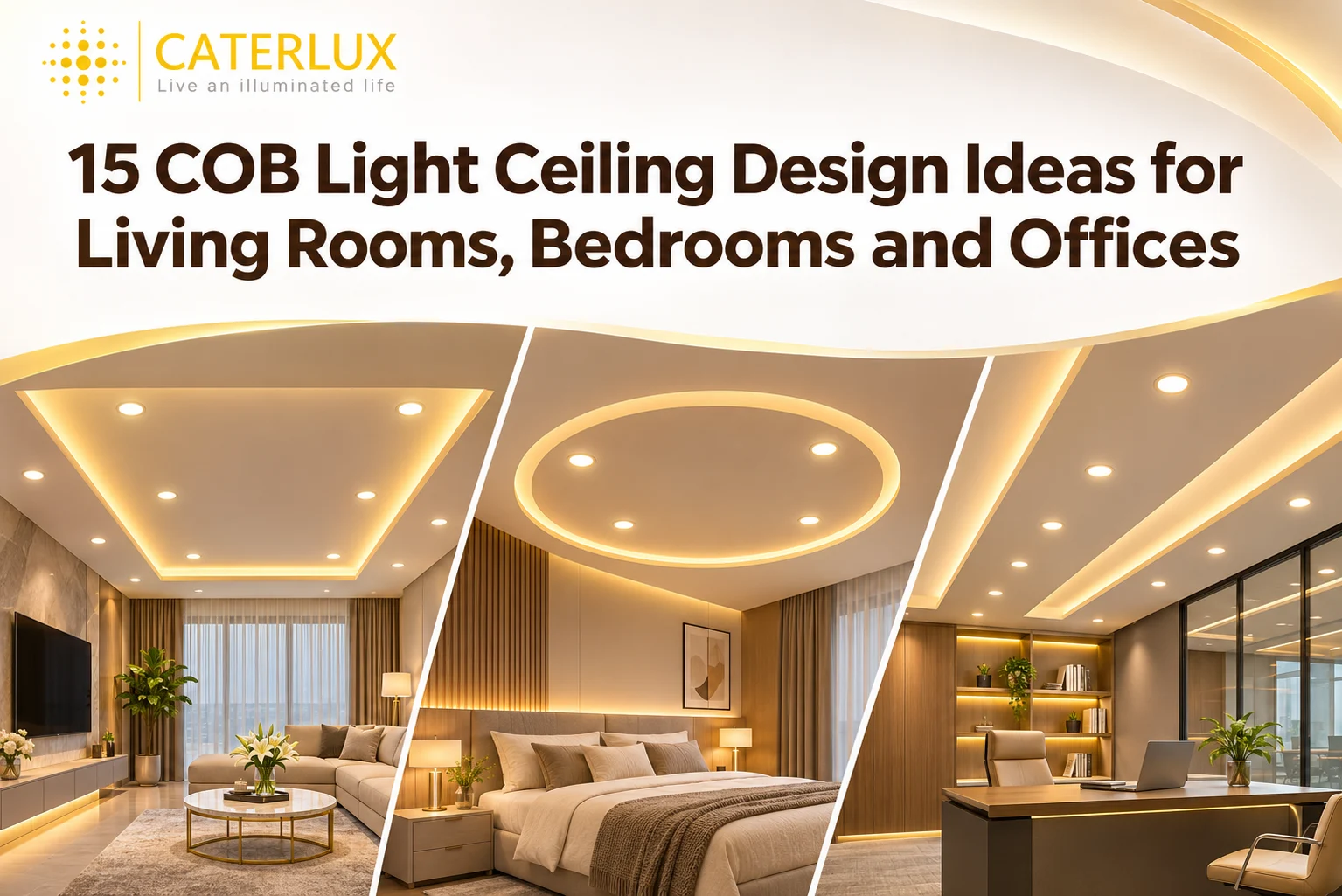
15 COB Light Ceiling Design Ideas for Living Rooms, Bedrooms and Offices
Good COB light design starts with one decision: where the light should land, not where the fixture should go. A ceiling full of bright dots looks busy and glares at you from every angle. A ceiling planned around the room’s seating, work areas and walls feels calm, even and finished.
COB (chip on board) lights pack many LED chips onto a single surface, which gives a smooth, uniform glow instead of a cluster of visible dots. That makes them a strong choice for false ceiling lighting, recessed COB lights, trimless downlights and ceiling spot lights in living room ceiling lights, bedrooms and offices. Caterlux designs architectural LED lighting, including recessed downlights, profile systems and magnetic track, for interiors where the ceiling plan matters as much as the fixture. Here are 15 ideas, followed by how to choose and how COB compares with SMD.
15 COB Light Ceiling Design Ideas
The best COB lights ceiling plans combine a few of these, not all of them.
1. Recessed COB ceiling lights
Fixtures sit flush in the ceiling, so you see light, not hardware. This is the cleanest base layer for any room, especially in a gypsum ceiling design.
2. COB spotlights for false ceilings
Adjustable spots set into a false ceiling can aim at art, shelves or a feature wall. Keep them away from the centre so they don’t glare at seated people.
3. COB lights with cove lighting
Pair recessed COB downlights with an LED cove at the ceiling edge. The cove gives soft ambient light and the COB lights handle visibility and tasks.
4. Layered ceiling lighting
Combine ambient, task and accent light on separate switches. Layered lighting lets the same ceiling work for cleaning, TV and dinner.
5. COB lights along ceiling borders
A row of COB lights near the room’s edge washes the walls and makes the room feel wider. Space them evenly and check the wall surface first.
6. Geometric COB light patterns
Squares, rectangles or circles of COB lights add design interest to POP ceiling lights layouts. Keep the pattern simple, or it will date quickly.
7. COB lights for tray ceilings
A tray ceiling has a recessed centre. Put COB spots on the raised border and a soft cove inside the tray for depth.
8. Minimalist ceiling spotlights
Fewer, trimless downlights in a clean grid give a quiet, modern ceiling. Skip decorative rings and keep the colour consistent.
9. COB lights above the living room seating area
Place downlights in front of and around the seating, not directly over heads. Add one dimmable circuit so the evening setting is softer.
10. COB lights for bedroom ceilings
Use low-glare, warm COB lights at the wardrobe and room edges, and avoid placing any directly over the bed. Dimming matters more here than brightness.
11. COB lights for office ceilings
Use neutral white, evenly spaced COB downlights with a low-glare optic. Aim to light desks evenly and avoid reflections on screens.
12. COB lights highlighting feature walls
Set narrow-beam COB spots about 30 to 40 cm from the wall to graze texture, stone or panelling. Accent lighting turns a plain wall into a focal point.
13. COB lights for dining areas
Centre a pendant or cluster over the table, then add dimmable COB lights around it for general light. The pendant sets the mood and the ceiling lights support it.
14. COB track lighting
A ceiling track with COB heads lets you move the light as furniture changes. It suits living rooms, studios and retail-style spaces.
15. Adjustable COB ceiling lights
Gimbal COB fixtures tilt and rotate, so you can aim them after furniture is placed. They’re useful where the layout isn’t final.
How to Choose the Right COB Lights for Your Ceiling
Getting COB light design right depends on a few specifications, not the look of the fixture.
Colour temperature. Warm white (2700K to 3000K) suits living rooms and bedrooms. Neutral white (about 4000K) suits offices and kitchens. The warm white vs cool white choice changes how a room feels more than almost anything else, so keep it consistent within a room.
CRI. Choose 90 or above where colours matter, such as living rooms, wardrobes and retail. Cheap COB lights with low CRI make skin and fabrics look flat.
Beam angle. Narrow beams (about 24 degrees) suit accent. Wide beams (about 60 degrees) suit general light.
Anti-glare design. Deeper recesses and shielded optics reduce glare. This matters most in offices and over seating.
Driver quality. A flicker-free, dimmable driver makes the difference between a comfortable ceiling and a tiring one. Confirm the dimming type before buying.
Spacing and quantity. As a starting point, space downlights roughly 1 to 1.5 m apart on a standard ceiling and adjust to the room. Ask your lighting designer for a layout rather than counting fixtures by area.
Plan the cable routes and ceiling depth before you finalise COB lights ceiling positions, because moving a downlight after the gypsum is closed is expensive.
COB vs SMD Lights for Ceiling Design
| Feature | COB | SMD |
|---|---|---|
| Light appearance | Smooth, single uniform source | Visible individual dots |
| Best use | Downlights, spotlights, accent | Panels, strips, diffused lights |
| Beam control | Strong, tighter beams possible | Wider, softer spread |
| Glare risk | Higher if unshielded | Lower when diffused |
| Brightness in small fixtures | High | Moderate |
| Typical ceiling use | Recessed COB lights, trimless downlights | Flat panels, cove strips |
Neither is better for every job. COB is the stronger choice for focused, clean-looking spots and downlights. SMD suits panels and strips where soft diffused light is the goal. Many good ceilings use both: SMD cove for ambient, COB spots for task and accent.
Conclusion
Strong COB light design is a layout exercise first and a product choice second. Decide what each part of the ceiling needs to do, then choose beam angle, colour temperature and CRI to match.
For recessed downlights, track systems and profile lighting designed for finished interiors, explore Caterlux at caterlux.in.
FAQs
1. What is the best COB light design for a living room ceiling?
Recessed COB downlights, cove lighting, and adjustable spotlights work well together to create balanced ambient and accent lighting.
2. How many COB lights are needed for a false ceiling?
As a starting point, space COB downlights around 1 to 1.5 metres apart. The final quantity depends on room size, ceiling height, and light output.
3. Which colour temperature is best for COB ceiling lights?
Warm white (2700K–3000K) suits living rooms and bedrooms, while neutral white (around 4000K) is suitable for offices and kitchens.
4. Are COB lights better than SMD lights for ceiling designs?
COB lights suit focused lighting and spotlights, while SMD lights work well for diffused panels and cove lighting. Both can be combined.
5. Where should COB lights be placed in a bedroom ceiling?
Place low-glare COB lights near room edges and wardrobes. Avoid positioning bright downlights directly above the bed for more comfortable lighting.