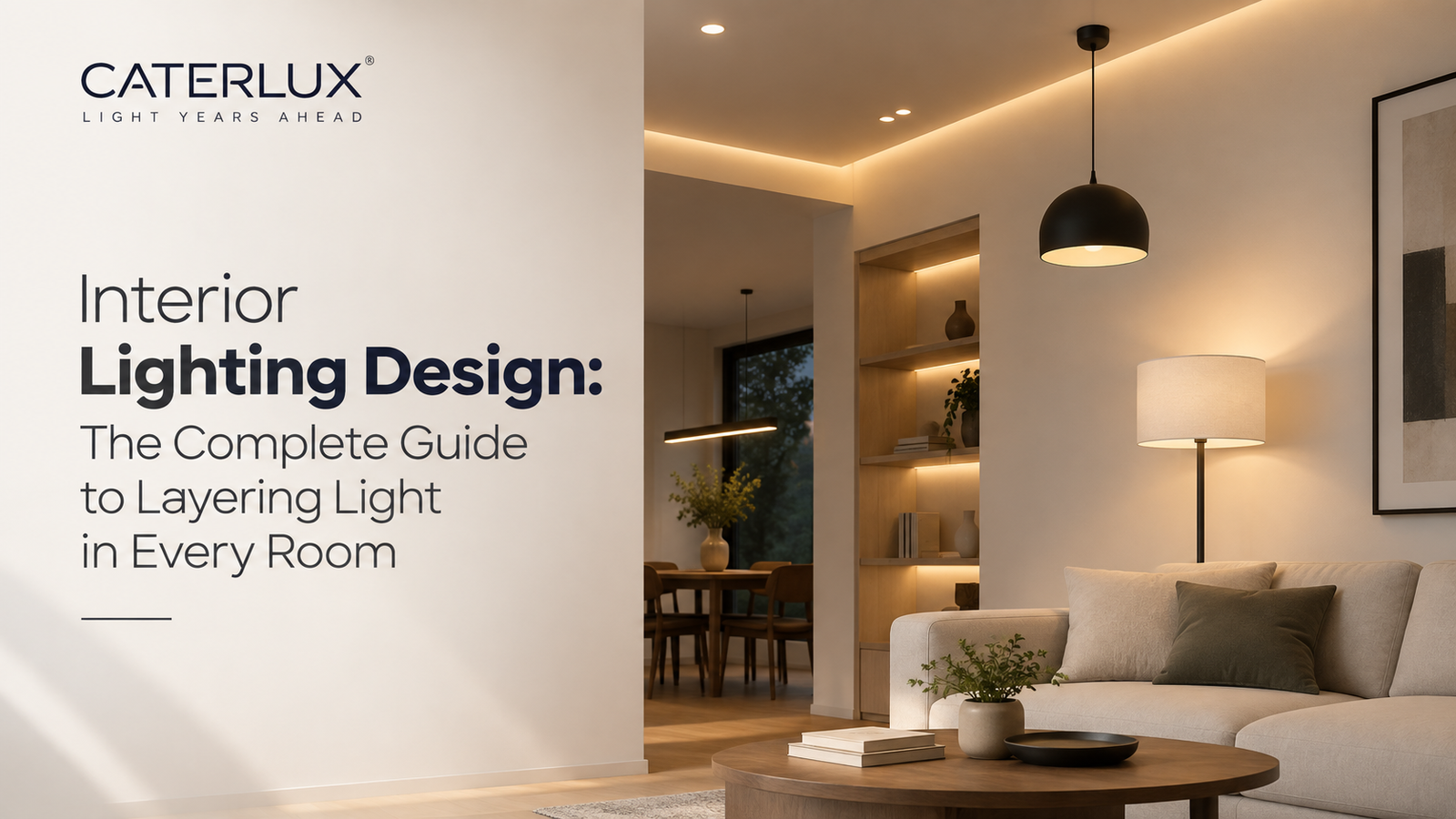
Interior Lighting Design: The Complete Guide to Layering Light in Every Room
Interior lighting design is the part of a home’s fit-out that most people get wrong — not because it’s complicated, but because it’s treated as a purchasing decision rather than a planning decision. The usual approach: pick fixtures that look good in a showroom, install them in the positions the electrician suggests, and then wonder why the space doesn’t feel right even though everything else is finished.
Layered lighting — ambient, task, and accent working together — is what separates a well-lit interior from one where the light is simply present. It requires thinking about each room’s functions, where natural light enters, which surfaces matter visually, and what atmosphere the room should produce at different times of day. Caterlux designs architectural LED lighting for residential and commercial interiors — their product range covers recessed downlights, LED profile systems, magnetic track lighting, and cove lighting — and their approach to interior lighting design is built around exactly this layering principle. This guide covers how to apply it room by room.
What Is Interior Lighting Design?
Interior lighting design is the deliberate planning of light sources within a space to serve different functions simultaneously — visibility, mood, visual hierarchy, and architectural emphasis — without any single function compromising the others.
It’s different from lighting selection. You can select excellent individual fixtures and still produce a poorly lit interior if they’re placed without a coherent plan. Interior lighting design considers the sources together: which layer is active at what intensity, where they’re positioned relative to surfaces and furniture, what colour temperature creates the right atmosphere for the room’s function, and how the layers interact when multiple circuits are running at once.
The 3 Main Layers of Interior Lighting
Ambient Lighting
Ambient lighting is the base layer — general illumination that gives a room its foundational visibility. It doesn’t need to be bright; it needs to be even and without harsh shadows.
False ceiling lighting in recessed positions, ceiling-mounted panels, and cove lighting that bounces light off the ceiling plane all work as ambient sources. The goal is to eliminate dark corners without creating glare, and to provide enough light that the space can be used without the other layers active.
Task Lighting
Task lighting serves specific activities: reading, cooking, applying makeup, working. It’s brighter than ambient, directed at the working surface, and positioned to avoid casting shadows across the task area.
Under-cabinet LED strips in a kitchen, a reading light positioned beside a bed, pendant lights over a kitchen island, and mirror lighting in a bathroom are all task lighting examples. Task lighting works independently of ambient — you can have it active while keeping the ambient layer low.
Accent Lighting
Accent lighting draws attention. Artwork, architectural features, textured walls, plants, and objects are all candidates for accent treatment — a directed spot or LED downlight that separates the subject from its background.
The ratio that works for accent: approximately 3:1 brightness relative to the ambient layer. Less than that and the accent doesn’t read clearly. More and it creates harsh contrast.
Read more: How to Choose the Right Lighting for Open-Concept Spaces
Popular Interior Lighting Ideas
Cove lighting — LED strip in a ceiling recess or cornice channel that throws light upward, illuminating the ceiling plane softly and creating depth without visible fixtures. One of the most effective ambient lighting approaches in residential interiors.
False ceiling lighting with recessed downlights — LED downlights set flush into a false ceiling grid. Works for ambient when distributed evenly, or for accent when clustered over specific areas. False ceiling lighting allows the lighting layout to be integrated into the architecture rather than attached to it.
Magnetic track lighting — a track system where fixtures attach magnetically and can be repositioned without tools. Ideal for accent and task functions in spaces where flexibility matters — living rooms, dining areas, studies. Caterlux’s magnetic track system is a particularly clean solution for this application.
LED profile and cove systems — linear profiles recessed into ceiling reveals, wall details, or furniture edges. Produces continuous, shadow-free light lines with no visible source. Used for ambient cove lighting and as feature accents.
Room-Wise Interior Lighting Design
Living Room
Living room lighting design needs to serve multiple functions — television viewing, conversation, reading, entertaining — and shift between them without full light scheme changes.
Three circuits minimum: ambient (cove or recessed downlights), accent (track or wall spotlights for art and features), and task (a floor lamp or table lamp near the reading position). Dimmer controls on each circuit allow the room to shift from bright general illumination to a low, warm evening setting within seconds.
Colour temperature: 2700K–3000K for a warm, residential character. Cooler temperatures make living rooms feel clinical.
Bedroom
Bedroom lighting design prioritises comfort and flexibility over brightness. Most bedrooms are over-lit — a single bright ceiling fixture that makes no distinction between “getting dressed” and “winding down.”
The right approach: ambient at low level (cove or indirect ceiling lighting), dedicated reading lights on each bedside (wall-mounted or pendant), and a task circuit near the wardrobe and dressing area. Each circuit independently dimmable.
LED downlights for bedroom lighting should be specified at low wattage and 2700K for the ambient layer — the kind of light that doesn’t feel harsh at 10 PM.
Kitchen
Kitchens need high ambient lighting (the counter surface where food is prepared requires 300–500 lux) and task lighting directly over key work surfaces.
Under-cabinet LED strip lighting is the most effective task lighting solution — it eliminates the shadow that overhead ambient creates when you stand at the counter. Island pendant lighting provides both task illumination and a design focal point.
Colour temperature: 3000K–4000K for kitchen environments where colour accuracy in food preparation matters.
Dining Area
A pendant or chandelier positioned directly over the dining table creates a natural visual anchor for the space. The pendant should hang 70–80cm above the table surface.
Supplement with dimmable ambient lighting in the room so the pendant isn’t the only source when the full space is in use. Dimming the ambient while keeping the pendant at a warm glow is what creates a dining atmosphere rather than general room lighting.
Bathroom
Bathroom lighting needs to serve two very different functions: bright, even illumination for grooming (where colour accuracy and shadow-free light at face level matter most) and softer ambient light for a relaxed experience.
Mirror lighting — vertical strips on both sides of the mirror rather than a single horizontal bar above — produces the most shadow-free facial illumination. A separate ambient circuit (recessed downlights or cove) can be dimmed for the latter function.
IP-rated fittings are mandatory in wet zones (within 60cm of water sources). Specified IP44 minimum for most bathroom zones; IP65 for direct shower areas.
How to Plan Lighting for a Room
Step 1 — Define the room’s functions. List every activity that happens there. The lighting plan needs to serve each one.
Step 2 — Identify the natural light. How much, from where, at what time of day. Artificial lighting supplements natural light; it shouldn’t fight it.
Step 3 — Plan the ambient layer first. Where will the base illumination come from? How evenly does it need to be distributed?
Step 4 — Add task positions. Where are the specific activities? What surface needs direct illumination?
Step 5 — Identify accent opportunities. What’s worth highlighting — art, texture, architecture?
Step 6 — Plan circuits and controls. Each layer should be on an independent dimmer circuit. This is the most important specification detail in how to plan lighting for a room — without dimming, layers can’t be balanced.
Step 7 — Specify colour temperature consistently. Don’t mix 2700K and 4000K sources in the same space. The visible difference is jarring.
Common Lighting Mistakes to Avoid
Relying on a single ceiling fixture. One central light produces flat, shadow-heavy illumination with no depth or atmosphere.
Ignoring dimming. Fixtures without dimmers are locked at full brightness. Full brightness is appropriate for about 20% of the time most rooms are used.
Wrong colour temperature. Cool white (5000K+) in a bedroom or living room creates discomfort. Warm white (2700K–3000K) in a task-heavy kitchen makes colour judgements difficult.
Insufficient task lighting at the kitchen counter. The most common practical complaint in residential kitchens — overhead ambient creates shadow at the counter when you stand in front of it. Under-cabinet lighting solves this.
Not coordinating fixture finishes. Mixing brushed brass, chrome, and matte black in one room fragments the visual language. Pick a finish language and apply it consistently.
Conclusion
Interior lighting design is a planning exercise before it’s a purchasing one. The layered lighting approach — ambient, task, accent — applied with the right colour temperature, circuit control, and fixture placement, produces interiors that feel genuinely different from spaces lit as afterthoughts.
Caterlux’s architectural LED range — profile lighting, magnetic track, recessed downlights, and cove systems — gives designers and homeowners the tools to execute this properly. Explore the full product range at caterlux.in.
FAQs
- What is interior lighting design?
Interior lighting design is the planned use of ambient, task, and accent lighting to improve visibility, comfort, mood, and visual appeal. - What are the three main layers of lighting?
The three main layers are ambient lighting for general illumination, task lighting for activities, and accent lighting for highlighting features. - How do you plan lighting for a room?
Define the room’s functions, assess natural light, plan ambient lighting, add task and accent lights, and use separate dimmable circuits. - What is the best lighting for home interiors?
Layered lighting with warm 2700K–3000K light is generally suitable for living rooms and bedrooms, while kitchens need brighter task lighting. - What lighting is best for a bedroom?
Bedroom lighting should combine low-level ambient lighting, bedside reading lights, and task lighting near wardrobes and dressing areas.