How to Choose the Right Lighting for Open-Concept Spaces
Open concept spaces look effortless when the lighting is right and frustrating when it isn’t. Without walls dividing kitchen from dining from living room, every lighting decision affects multiple zones at once — and the margin for error is smaller than in a standard room.
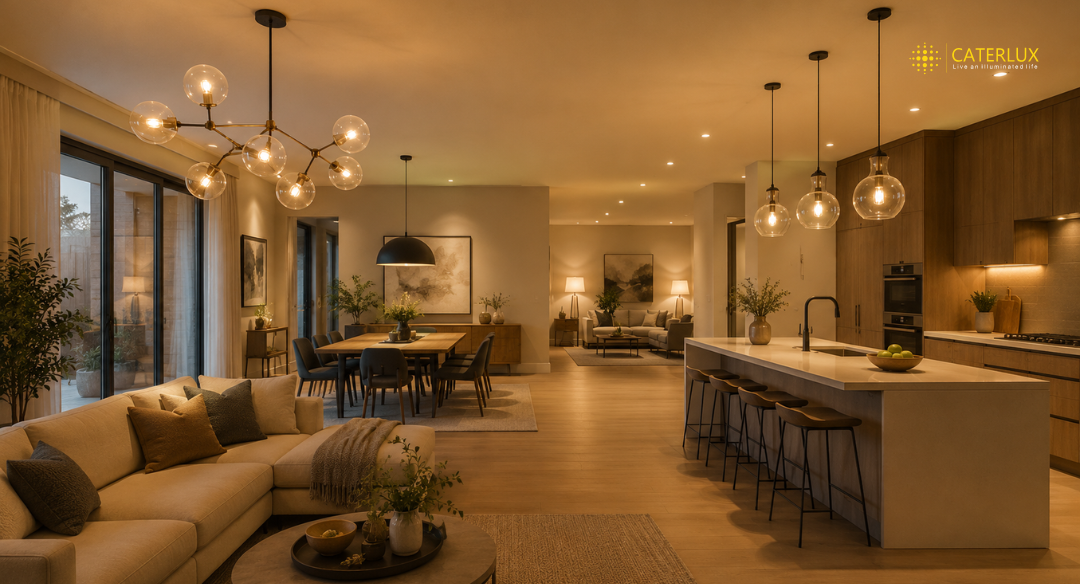
Open concept lighting done well creates distinct atmospheres within a shared footprint: task-oriented brightness in the kitchen, warm ambient lighting in the dining zone, adjustable accent lighting in the living area. It’s one of the more demanding interior lighting design challenges precisely because the whole space is always visible at once. Caterlux designs architectural LED solutions for exactly these conditions — residential interiors where the lighting has to work across zones without fixtures that fight each other. Their range covers everything from recessed downlights and LED profile lights to magnetic track systems and acoustic lighting for open-plan environments.
This guide covers how to approach open floor plan lighting from first principles.
What Makes Open-Concept Lighting Different?
In a conventional room, lighting is contained. In an open plan, there’s no such containment — light from the kitchen spills into the dining area, and a pendant over the dining table affects how the living room reads. Every choice interacts with every other.
This creates two specific challenges. First, you need enough differentiation between zones that each area feels purposeful — not like everything is lit by the same flat overhead glow. Second, you need enough visual coherence that the space reads as one considered interior rather than several unrelated lighting decisions placed in the same room.
Both require deliberate thinking before a single fixture is purchased.
Start with a Layered Lighting Plan
Lighting for large rooms requires multiple layers — ambient, task, and accent — operating independently but cohesively.
Ambient lighting is the background layer — general illumination that defines the overall brightness of a space. Recessed lighting arranged across the ceiling plane is the most common approach in open-plan interiors. The goal is even distribution without harsh shadows.
Task lighting serves specific activities. Kitchen countertops need direct illumination for cooking. A reading corner needs directed light. A home office zone needs controlled brightness without glare. Task lighting supplements ambient, not replaces it.
Accent lighting defines character. A wall washer that highlights texture, a spotlight on artwork, an LED profile light in a ceiling cove that throws light upward — these are the layers that give a space visual depth beyond functional illumination.
In a typical open-plan home, all three layers are operating simultaneously but at different intensities in different zones. A dimmer-connected system allows each layer to be adjusted without affecting the others.
Choosing the Right Fixtures for Each Zone
Kitchen — the kitchen zone needs the highest maintained illumination. Kitchen lighting ideas for open-plan spaces typically combine recessed downlights for general coverage with under-cabinet LED strips for task lighting at the counter surface. The counter surface is where detail work happens — chopping, reading recipes, plating — and overhead ambient alone rarely gives enough light at that plane.
Dining area — pendant lights for living room and dining zones are the most common approach. A pendant or cluster of pendants over the dining table does two things: it defines the zone visually and creates an intimate pool of light that makes the dining area feel distinct from the kitchen and living spaces around it. Ceiling height determines how low the pendants should hang — generally 70–80cm above the table surface is the practical range.
Living area — the living space in an open plan usually needs the most flexibility. This is where adjustable track lighting and dimmable downlights earn their value. Lighting fixture placement here should account for the sofa position, any artwork or feature walls, and the TV wall (which should have some backlighting to reduce the contrast between the screen and its surroundings).
For a cohesive approach across all three zones, Caterlux’s Magnetic Lighting System allows individual fixtures to be repositioned along the track without electrical work — useful in open-plan spaces where the furniture layout shifts or where zoning requirements change over time.
How to Create a Cohesive Look?
The most common mistake in open-plan lighting is mixing finishes and styles without intention. Chrome in the kitchen, matte black in the dining zone, and brushed gold in the living area don’t cohere — even if each individual fixture is nice on its own.
Pick a finish language first and stay in it. Matte black, brushed steel, brass, white — choose one and apply it consistently across fixture types. It’s the single quickest way to make diverse fixture types read as a single considered scheme.
Colour temperature matters equally. Mixing 3000K pendants in the dining area with 4000K recessed lights in the kitchen creates a warm/cool split that’s visible across the space. For most residential open-plan interiors, 2700K–3000K throughout produces the most harmonious result.
Contemporary lighting design for open plans also increasingly uses concealment — recessed profiles, cove lighting, concealed LED strips — to let the light be visible without the fitting being the focal point.
Lighting for Large Rooms: Size and Placement Tips
Lighting for large rooms requires more fixtures than most people plan for, placed more thoughtfully than a standard room needs.
A rough planning rule: for ambient recessed lighting, space fixtures no more than twice the ceiling height apart. A 10-foot ceiling suggests downlights no more than 20 feet from each other — which means most large open-plan spaces need multiple circuits, not one.
Perimeter lighting — fixtures placed around the room’s edges rather than only at the centre — is particularly effective in large rooms. It makes the walls feel closer and reduces the “big empty ceiling” effect that large spaces can produce with only centre-mounted ambient fixtures.
Scale matters for statement fixtures. A pendant that works in a standard dining room can disappear in a large open-plan space. Go larger than feels comfortable in the showroom — the ceiling height and visual competition from the wider space will absorb the scale.
Modern Lighting Ideas for Open-Concept Spaces
Modern lighting ideas for open concept lighting in 2026 lean heavily on flexibility, concealment, and zone definition.
Zoned track lighting — modern ceiling lights on an adjustable track allow different zones to be lit independently with a single installation. Caterlux’s magnetic track system takes this further with tool-free fixture repositioning. Particularly useful for spaces where the layout isn’t fixed.
LED profile cove lighting — a continuous LED profile light installed in a ceiling cove throws light upward to illuminate the ceiling plane softly. It’s one of the most effective ways to add depth to a large open space without adding visible fixtures. Warm output (2700K–3000K) in a bedroom-adjacent zone keeps the transition from kitchen to living area from feeling abrupt.
Acoustic lighting — in open-plan offices and large commercial spaces, home lighting ideas increasingly borrow from commercial practice. Caterlux’s Acoustic Lighting Series combines sound-absorbing baffles with LED illumination — addressing two challenges (noise and light) with a single ceiling installation. Worth considering for open-plan home offices and multi-use spaces.
Decorative pixel lighting — for feature walls and architectural accent applications, Caterlux’s Canon Pixel range offers individually addressable pixel fixtures that create pattern and depth on vertical surfaces. A strong way to anchor one zone of a large open space without adding furniture or partition.
Common Open-Concept Lighting Mistakes to Avoid
Relying on one circuit for everything. A single on/off for the whole space means every zone is at the same brightness level. Multiple circuits — ideally each on a dimmer — are not optional in open-plan spaces.
Undersizing statement fixtures. A dining pendant that looks perfect in a showroom display often reads as too small once installed under a high ceiling with an open plan around it. Err larger.
Ignoring the transition between zones. Adjacent zones with dramatically different colour temperatures or brightness levels create a visual discontinuity that makes the space feel unresolved. Transitions should be gradual.
Not planning for the TV wall. A completely dark wall behind a bright screen causes eye strain over extended viewing. Soft bias lighting behind the television reduces the contrast.
Forgetting outdoor sight lines. If the open-plan space looks onto a terrace, garden, or balcony, the interior lighting creates reflections in the glass after dark. Plan exterior lighting to reduce this effect.
Conclusion
Open concept lighting is a planning problem before it’s a product problem. Define the zones, separate the layers, keep finishes consistent and colour temperature coherent — fixture choices follow from those decisions.
For residential and commercial open-plan projects where the lighting needs to work at an architectural level, Caterlux’s range — from their Pro Series downlights and LED profile systems to the Magnetic Lighting System and Acoustic Lighting Series — covers the full picture. Visit caterlux.in to explore products and completed projects.