LED vs Traditional Architectural Lighting: Which Is Better?
LED architectural lighting has replaced most traditional sources in serious design work — not because it’s fashionable, but because it performs better on every metric that matters for architectural applications: energy consumption, lifespan, optical precision, and the range of effects it can produce in a space.
For new residential, commercial, and institutional projects where performance and energy-efficient architectural lighting both matter, LED is the default. Caterlux designs architectural LED fixtures for premium residential and commercial interiors in India — magnetic track systems, linear wall washers, acoustic lighting, and pro-series downlights — and the comparison between LED and traditional lighting is something their products make concrete.
What Is Architectural Lighting?
Architectural lighting is the deliberate integration of light sources into a building’s design — not just to illuminate a space, but to shape how it reads, feels, and functions. It’s the difference between lighting installed in a room and lighting that’s designed as part of the room.
Modern architectural lighting involves layers: ambient light for general visibility, task light for specific activities, and accent light to direct attention and create depth. The fixtures may be invisible — recessed into ceilings or integrated into profile channels — or they may be visible and intentionally decorative. In either case, the quality of the light source determines how well those layers work.
What Is LED Architectural Lighting?
LED architectural lighting uses light-emitting diodes as the source within architecturally specified fixtures — downlights, track lights, wall washers, linear profiles, and custom fixtures designed to integrate with building elements rather than simply attach to surfaces.
The technical distinction from standard consumer LED products is in optical precision, colour consistency, and CRI (colour rendering index). Architectural LED fixtures are built to deliver specific beam angles, maintain colour accuracy across the fixture lifetime, and hold their rated lumen output rather than degrading quickly. These are the properties that matter when multiple fixtures need to produce a consistent effect across a large space.
How Is Traditional Lighting Different From LED Lighting?
Traditional architectural light sources include incandescent lamps, halogen bulbs, fluorescent tubes, metal halide, and high-pressure sodium. Each has different efficiency characteristics and was specified for different applications before LED became viable.
Incandescent and halogen produce warm, continuous-spectrum light with good colour rendering, but at very low efficiency — typically 10–15 lumens per watt. Most of the energy input becomes heat, not light.
Fluorescent improved efficiency significantly (50–100 lumens per watt) but introduced colour quality compromises — lower CRI, flickering at low dimming levels, and a spectrum that renders some colours inaccurately.
Metal halide and HPS were standard for commercial and outdoor architectural lighting where high output was needed, but they require warm-up time, have poor colour rendering (especially HPS), and generate significant heat.
LED replaces all of these with a single source type that can be tuned for different colour temperatures, achieves 80–200+ lumens per watt, starts instantly, and maintains performance without the maintenance overhead that traditional sources require.
LED vs Traditional Lighting: What’s the Difference?
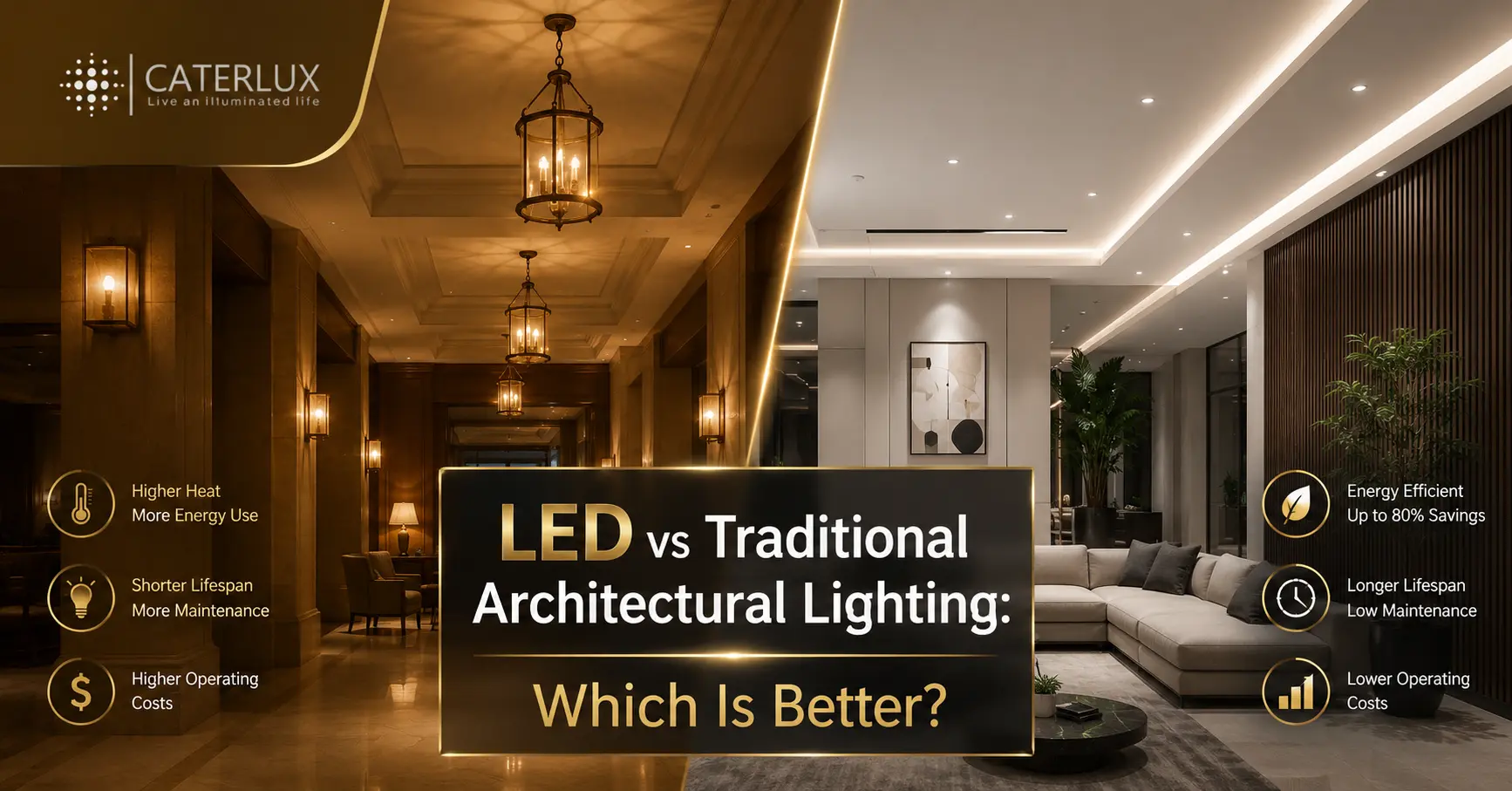
The traditional vs led lighting comparison across the metrics that matter for architectural projects:
| Feature | LED Architectural Lighting | Traditional Lighting |
| Energy consumption | 80–200+ lm/W | 10–100 lm/W depending on type |
| Lifespan | 25,000–100,000 hours | 1,000–20,000 hours |
| Maintenance | Minimal — long replacement intervals | Regular lamp changes, ballast failure |
| Design flexibility | High — dimmable, tunable, precise beam angles | Limited — fixed colour temp, less optical control |
| Heat output | Low | High (significant for ceiling and enclosed fittings) |
| Cost over time | Higher upfront, significantly lower total | Lower upfront, higher running and maintenance costs |
| CRI (colour rendering) | 80–98+ depending on specification | Variable — halogen high, HPS poor |
| Dimming performance | Smooth to 1% with DALI/0–10V | Halogen good; fluorescent poor at low levels |
The cost over time comparison is where most buyers underestimate the advantage of LED architectural lighting. A fitting that runs 3,000 hours per year and lasts 50,000 hours stays in service for over 16 years. Traditional halogen at 2,000 hours requires replacement 25 times over the same period.
Why Is LED Architectural Lighting More Energy Efficient?
Traditional light sources convert most of their energy input into heat. Incandescent bulbs, for example, convert only around 5% of electrical energy into visible light, while most of the remaining energy is released as heat and infrared radiation. This makes traditional lighting significantly less energy-efficient, particularly in large commercial and architectural spaces where hundreds of fixtures may operate for long hours.
LEDs work very differently. They produce light through electroluminescence, where electrical energy is converted directly into photons instead of heating a filament until it glows. Modern LED chips can convert around 40–60% of electrical energy into visible light, making them substantially more efficient than incandescent and halogen alternatives. The remaining heat is managed through integrated heat sinks rather than being radiated directly into the surrounding space.
For energy-efficient architectural lighting at building scale, this difference can translate into substantial operational savings. A 100-room hotel replacing traditional halogen downlights with LED architectural fixtures may reduce lighting-related energy consumption by approximately 60–75%. Over a 10-year operating period, these savings can significantly offset the initial fixture investment while also reducing maintenance and replacement requirements.
Sustainable lighting design based on LED technology can also reduce HVAC loads in enclosed environments. Since LED fixtures release considerably less heat into occupied spaces, air-conditioning systems do not need to work as hard to maintain comfortable indoor temperatures. In South Indian climates, where cooling systems often operate for much of the year, this secondary energy saving can become particularly valuable. Energy-efficient lighting is therefore an important component of sustainable building strategies and is increasingly considered within green building frameworks such as IGBC and GRIHA.
Beyond energy savings, lighting also plays an important role in shaping how a space looks, feels, and functions. Understanding how architectural lighting transforms interior spaces can help architects and designers create environments that balance visual comfort, functionality, aesthetics, and energy efficiency.
Where Can You Use Architectural LED Fixtures?
LED architectural lighting covers every application that traditional sources handled, and several that they couldn’t.
Cove and profile lighting — LED strip in aluminium profiles for indirect cove lighting is one of the most common architectural applications. The even, shadow-free output is impossible to achieve with traditional point sources.
Track and magnetic systems — LED track lighting for retail, galleries, and residential spaces, with adjustable fixtures that direct light where needed. Caterlux’s magnetic track system allows repositioning without tools.
Facade and exterior — outdoor architectural lighting on building elevations, landscape features, and garden elements. LED handles the IP ratings required for outdoor exposure with significantly longer service life than traditional exterior sources.
Downlights and spotlights — precision LED downlights for residences, offices, and hospitality spaces. High CRI versions (90+) accurately render colours — important in retail and hospitality where visual appearance affects buying decisions.
Linear LED lighting — continuous linear fixtures for office ceilings, retail shelving, and feature walls. Commercial architectural lighting at large scale almost exclusively uses linear LED systems now.
Acoustic lighting — a newer category that integrates sound-absorbing baffles with LED illumination. Caterlux’s acoustic lighting range addresses both noise and light in open-plan commercial environments.
How Do You Choose the Right Architectural Lighting for Your Project?
Start with the application. Retail display, residential ambience, commercial ceiling, and outdoor facade all need different fixture types, colour temperatures, and CRI values.
Specify CRI correctly. For most residential work, CRI 90+ is appropriate. For retail, jewellery, or art display, CRI 95+ ensures accurate colour rendering. Using lower CRI to save cost produces a noticeable quality reduction in how the space looks.
Check dimming compatibility. A smart LED lighting system integrated with DALI or 0–10V controls requires fixtures that support that protocol. Confirm compatibility before specifying.
Consider the fixture’s integration with the architecture. The best architectural LED fixtures disappear into the building — recessed profiles, flush downlights, concealed channels. Contemporary lighting design treats the fixture as infrastructure, not decoration.
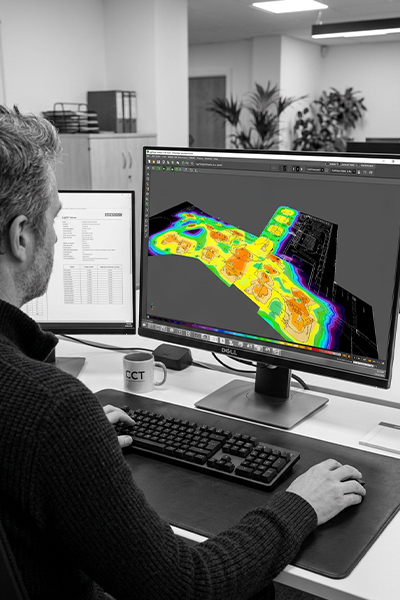
Work with a manufacturer who provides photometric data. Beam angles, lumen output at various distances, and colour temperature accuracy should all be documented and verifiable, not estimated.
LED or Traditional Lighting: Which One Should You Choose?
For new construction and renovation projects, the traditional vs led lighting decision has a clear answer — LED architectural lighting is the correct specification in almost every context. The energy efficiency, lifespan, and design flexibility advantages are real and measurable. Traditional sources remain relevant only in very specific circumstances — heritage restoration where the exact lamp character is architecturally specified, or niche applications where a particular light quality can’t be replicated in LED (increasingly rare as the technology matures).
The comparison isn’t really between LED and traditional anymore. It’s between different categories and quality tiers of LED — commodity versus architectural grade, basic dimming versus full scene control.
Conclusion
LED architectural lighting delivers on the metrics that matter: energy efficiency, longevity, design flexibility, and optical quality. The comparison with traditional sources becomes more straightforward every year as LED technology matures and pricing decreases.
For architectural projects where light quality defines the experience — residential interiors, hospitality, retail, commercial offices — Caterlux’s range of architectural LED fixtures provides the precision and system integration that consumer-grade products can’t match. Explore the full range at caterlux.in.
FAQs
- Is LED architectural lighting better than traditional lighting?
Yes. LED lighting is more energy-efficient, lasts longer, and offers better design flexibility for modern spaces. - Are architectural LED fixtures energy efficient?
Yes. They use less electricity and help reduce long-term lighting and maintenance costs. - Where can LED architectural lighting be used?
It is ideal for homes, offices, hotels, retail stores, facades, and commercial interiors. - Is LED lighting suitable for sustainable lighting design?
Yes. LED lighting supports sustainable building practices by reducing energy consumption and heat generation. - How long do architectural LED fixtures last?
Most high-quality LED fixtures last between 25,000 and 100,000 hours, depending on usage and specifications.