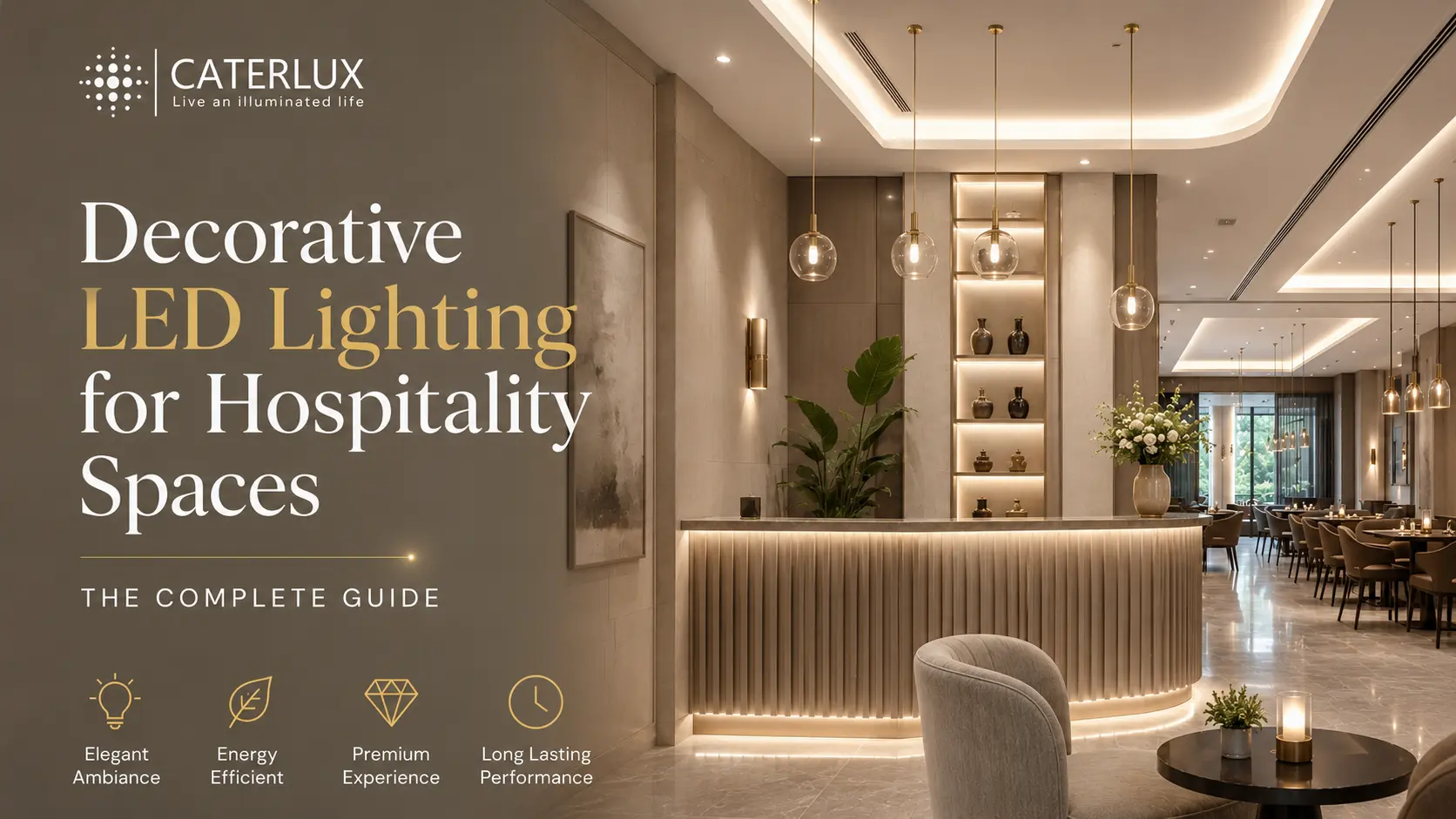
Decorative LED Lighting for Hospitality Spaces: The Complete Guide
Walk into a restaurant that’s getting it right and you feel the difference before you read the menu. The light is warm, the shadows are soft, every table looks like a good place to be. That quality isn’t accidental — it’s the result of deliberate decorative LED lighting decisions made by designers who understand how light shapes experience.
Hospitality lighting design is one of the most consequential choices a restaurant or hotel makes. Pendants, wall sconces, cove lighting, and feature fixtures determine the ambience of a space more than furniture does. Guests stay longer, spend more, and return more often when the lighting makes them feel comfortable. Getting it wrong produces the opposite effect.
Caterlux manufactures commercial LED lighting solutions and hospitality interior lighting for restaurants and hotels across India — products designed for the specific demands of commercial hospitality environments: longevity, consistent colour rendering, and fixtures that look as good in year three as they did on opening night.
What Is Decorative LED Lighting?
Decorative LED lighting refers to light fixtures that serve both a functional and an aesthetic purpose. Unlike purely utility lighting — a recessed downlight, a fluorescent tube — decorative LED fixtures are part of the visual design of the space. Pendant lights hanging over a dining bar, backlit panels behind a hotel reception desk, sculptural wall sconces in a corridor — these are all elements of a decorative lighting scheme.
The LED technology behind them has changed what’s possible. Colour temperature control, dimmability, long service life, and energy efficiency all combine in a way that older decorative fixture technologies — incandescent, halogen, CFL — couldn’t match. Modern decorative LED fixtures give designers creative freedom without the maintenance burden that made elaborate hospitality lighting expensive to operate.
Why Restaurants and Hotels Prefer Decorative LED Lighting
The hospitality industry adopted LED decorative fixtures for practical reasons before aesthetic ones.
Energy bills in commercial spaces are significant. A restaurant running 15 hours a day, six days a week, with 80 to 100 light points cannot afford the operating cost of incandescent or halogen sources. LED lighting for the hospitality industry reduces energy consumption at those light points by 60–80% compared to incandescent sources. Over a 10-year operating period, the total cost saving is substantial.
Maintenance matters even more. Replacing bulbs in pendant fixtures above a dining floor, in ceiling coves, or in wall sconces in a hotel corridor requires ladder work, downtime, and repeat costs. LED sources with 25,000–50,000 hour lifespans eliminate most of that maintenance cycle over the same 10 years.
How Lighting Influences Guest Experience
The research on this is consistent. People rate food higher when they eat in warmer, dimmer light. They stay longer at tables. They report feeling more relaxed. Ambient LED lighting that creates a warm, layered environment produces measurable differences in guest satisfaction and average spend.
The mechanism is partly physiological — warm light (2700–3000K) triggers relaxation responses — and partly aesthetic. A space with varied light intensity, where some zones are brighter than others, feels three-dimensional and designed. A flat, uniformly lit room feels institutional regardless of the furniture quality.
This is why hospitality lighting design for restaurants focuses on layering: task light at the table, ambient light throughout the space, accent light on architectural features and artwork, and decorative LED fixtures that function as visual anchors even when they’re not the primary light source.
Best Decorative LED Lighting Ideas for Restaurants
Pendant clusters over dining tables. Decorative lighting for restaurants starts here — a group of pendants hung at varying heights creates a focal point and defines the seating zone. Pendant restaurant LED lighting works best at 700–850mm above the table surface — close enough to illuminate the table without creating glare for seated diners.
Cove and valance strips. Indirect restaurant LED lighting from LED strips installed in ceiling coves or behind valances creates a soft glow that lifts the perception of ceiling height. This is one of the most cost-effective restaurant ambient lighting tools available.
Backlit panels and feature walls. A wall with integrated LED backlighting — behind textured material, frosted glass, or decorative screens — becomes a visual anchor for the room. The uniform glow from a well-installed backlit feature reads as high quality.
Edison-style pendant lights for restaurants. For casual dining, beer halls, and industrial aesthetic spaces, visible filament LED bulbs in pendant fittings maintain warmth and character. These are energy efficient LED lighting products that look like incandescent but run cool and last far longer.
Concealed accent downlights. Artwork, bottles behind a bar, and interior architectural elements benefit from narrow-beam accent downlights. These are functional rather than decorative, but they support the overall lighting scheme by adding depth.
Decorative Lighting Ideas for Hotel Spaces
Hotel lighting design starts at the lobby. Hotel lobby lighting needs to do two things simultaneously: create a positive first impression and provide sufficient light for navigation and check-in tasks. A chandelier or statement decorative LED fixture at lobby entry establishes the property’s aesthetic. Perimeter wall sconces and cove lighting handle the ambient fill.
Corridor lighting in hotels is often an afterthought and rarely should be. LED wall lights for hotels at consistent intervals, with warm colour temperature and low glare, make corridors feel residential rather than institutional.
Restaurant and bar within hotels follow the same layering principles as standalone restaurants — but with the additional consideration of operating across multiple lighting modes through the day (breakfast service, afternoon, dinner) without refitting.
Luxury hospitality lighting for suites and high-end room categories uses dimmer-controlled bedside reading lights, atmospheric ceiling sources, and bathroom lighting that provides both task performance and a spa-like quality.
How Ambient LED Lighting Improves Guest Experience
Ambient LED lighting is the baseline layer — the light that fills the space when no specific task is being performed. Getting it right means choosing the correct colour temperature (2700–3000K for most hospitality environments), the right intensity (enough to see comfortably, not enough to feel exposed), and the right source distribution (even fill without visible hotspots).
The improvement this lighting layer creates in guest experience is cumulative. It’s rarely the thing a guest consciously notices. It’s what they notice when it’s wrong — a room that feels too bright, too flat, or too cold.
Commercial decorative lighting in hospitality works when ambient and decorative layers reinforce each other. The decorative LED fixtures catch the eye; the ambient layer ensures the room reads as complete rather than theatrical.
Choosing the Right Decorative LED Fixtures
Colour temperature consistency. All decorative LED fixtures in a space should be within the same colour temperature band — ideally ±100K. Mixed colour temperatures in the same room create an incoherent visual quality. Most hospitality environments use 2700–3000K.
CRI 90 or above. Food, fabric, and skin tones look significantly better under high-CRI light. Any fixture in a restaurant or hotel space should specify CRI 90 minimum. CRI 80 products are noticeably less flattering under close comparison.
Dimmability. Most hospitality venues run multiple service periods through the day, each requiring different intensity. Ensure the decorative LED fixtures and their drivers are dimmable — and that the dimmer type is compatible. LED drivers are not compatible with all dimmer types.
IP rating for specific areas. Bar countertops, bathroom spaces, and outdoor terraces need fixtures rated for moisture exposure. IP44 minimum for splash zones; IP65 for fully exposed outdoor installations.
Fixture scale. A pendant that looks proportionate in a product photograph may appear small above a high ceiling or in a large dining room. Check pendant dimensions against the actual installation space before ordering.
Things to Consider Before Selecting Hospitality Lighting
Daylight integration. Spaces that receive natural light during the day need fixture selections that complement, not competes with, daylight. Controllable colour temperature (tunable white) or careful zoning separates day and evening modes.
Maintenance access. High ceilings, tight ceiling voids, and architectural features that look spectacular can create maintenance headaches. The best architectural decorative lighting specification accounts for how fixtures will be accessed for the inevitable lamp or driver change.
Lifecycle cost. Purchase price is rarely the most important cost metric for hospitality lighting. Factor energy consumption, expected driver lifespan, and replacement access into the product selection.
Supplier reliability. Products that are discontinued or changed in specification create matching problems when fixtures need replacement. Choose suppliers with stable product lines and local support.
Caterlux maintains consistent product lines for commercial applications, with CRI 90+ specifications and full dimmability across their hospitality decorative LED range. Their products are tested for the 15+ hour daily operating cycles typical in Indian restaurant and hotel environments.
Are Decorative LED Lights Energy Efficient?
Yes, and significantly more so than the sources they replace. A decorative LED pendant consuming 8W produces the same light output as a 60W incandescent source. Modern LED lighting for the hospitality industry has reached efficiency levels where running costs for equivalent light output are 75–85% lower than halogen alternatives.
The energy efficient LED lighting case for hospitality is strengthened by the operating hours involved. A restaurant pendant operating 12 hours daily, 300 days per year, at 60W incandescent costs approximately ₹3,240 per year in electricity (at ₹6/kWh). The LED equivalent costs approximately ₹432. Multiply that by 50 light points and the annual saving approaches ₹1.4 lakhs for a single restaurant.
How to Layer Lighting in Restaurants and Hotels
Layer 1 — Ambient. The general fill light that allows navigation and basic visibility. Cove lighting, indirect wall-wash fixtures, and diffuse ceiling sources.
Layer 2 — Task. Directional light for specific functions — table lighting in restaurants, reading light in hotel rooms, display lighting behind bars.
Layer 3 — Accent. Focused light on artwork, feature walls, architectural elements, and product displays. Creates depth and hierarchy.
Layer 4 — Decorative. Decorative lighting for restaurants and hotels — pendants, chandeliers, sconces — functions as a design element regardless of its light output. Decorative LED lighting at this layer contributes to the aesthetic as much as the illumination.
Good modern decorative lighting design uses all four layers. Spaces that rely on a single layer, often a uniform downlight grid, lack the depth and variation that makes a room feel considered.
Conclusion
Decorative LED lighting in hospitality is the intersection of aesthetics, psychology, and operational efficiency. It influences how guests feel in a space, how long they stay, and whether they come back. Getting it right requires a deliberate approach to layering, colour temperature consistency, CRI specification, and fixture selection that matches the space’s scale and character.
For restaurants and hotels specifying commercial decorative lighting and decorative LED lighting for new openings or renovations, Caterlux provides commercial-grade LED lighting for hospitality industry environments designed for Indian operating demands. Visit caterlux.in for product specifications and project consultation
FAQs
- What is decorative LED lighting in hospitality spaces?
Decorative LED lighting adds style and ambience while providing functional lighting in restaurants, hotels, cafés, and lounges. - Which LED lighting is best for restaurants?
Warm ambient LED lighting (2700K–3000K) with pendant lights and cove lighting works best for most restaurant spaces. - Why is hospitality lighting design important?
Good hospitality lighting design improves guest comfort, enhances interiors, and creates a memorable dining or stay experience. - Are decorative LED lights energy efficient for commercial spaces?
Yes. Decorative LED lights consume less electricity, last longer, and reduce maintenance costs for commercial hospitality spaces. - How do I choose decorative lighting for restaurants and hotels?
Choose fixtures based on colour temperature, CRI rating, dimmability, space size, and the overall interior design theme.