Profile Light for Kitchen: Why Your Kitchen Deserves Better Lighting
Most people spend a surprising amount of time thinking about their kitchen’s tiles, countertops, and cabinets – and almost no time thinking about the lighting. Then they’re left squinting under a single ceiling bulb while chopping vegetables at night, wondering why the space feels so flat despite all the effort that went into designing it.
Lighting is what ties a kitchen together. And if you want something that’s clean, modern, and actually functional, a profile light for kitchen spaces is where most designers and homeowners are landing today. It sits flush, distributes light evenly, and does a job that a bulb in the middle of the ceiling simply can’t.
This blog breaks down everything you need to know before choosing kitchen lighting – from profile lights to ceiling options to what actually works in a small kitchen.
What Is a Profile Light and Why Does It Work So Well in a Kitchen?
A profile light is essentially an LED strip housed inside an aluminium channel or extrusion. The channel shapes and directs the light, protects the strip from moisture and dust, and gives the whole installation a clean finished look rather than an exposed wire look.
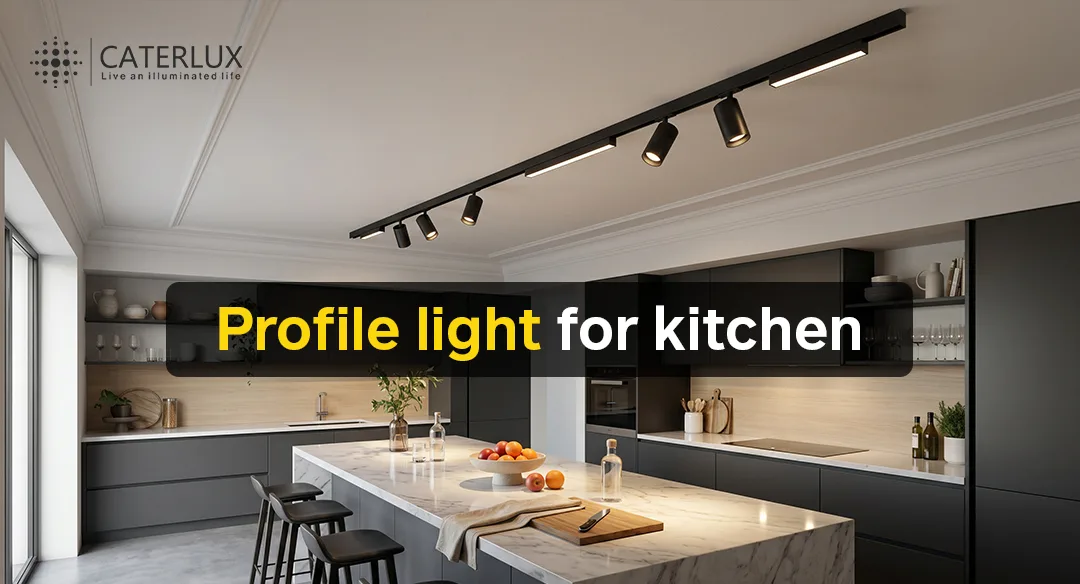
In a kitchen specifically, profile light for kitchen installations are used along cabinet undersides, inside shelves, along toe kicks, and even recessed into ceilings or pelmets above upper cabinets. The result is layered lighting – task light where you need to see clearly, ambient light that fills the room, and accent light that highlights what’s worth showing off.
It’s not just about aesthetics either. A well-placed profile light reduces shadows on your work surface, which is a real safety and convenience factor when you’re handling knives or hot cookware.
Why Magnetic Track Lighting Is the Smarter Choice for Kitchens?
If you’re looking at profile lighting for your kitchen and want something that goes a step further – Caterlux’s magnetic lighting system is worth knowing about.
Magnetic track lighting works on a recessed or surface-mounted track that uses magnets to hold the light fixtures in place. The big advantage for a kitchen setting is flexibility. You can reposition fixtures along the track without any wiring work, any tools, or calling in an electrician. A spotlight that was over the island can move to the prep counter in seconds. Fixtures simply click in and pull out.
For kitchen design specifically, this matters more than most spaces. Kitchens get reorganised. Counter layouts change. Appliances move. Magnetic track lighting moves with your kitchen rather than being fixed to a layout you made two years ago.
Beyond flexibility, the installation itself is cleaner. No individual wiring per fixture, no messy retrofits, no visible hardware. Caterlux’s magnetic systems sit recessed and flush – giving kitchens that seamless modern ceiling look that’s become standard in well-designed homes.
The fixtures themselves also produce high-quality, focused light that works well in both task and ambient roles – something that matters a lot in a space where you’re cooking, eating, and spending real time.
Features to Look For LED Lights for Kitchen Cabinets
The most popular use of profile lighting in a kitchen is under the cabinet, and for good reason. LED lights for kitchen cabinets placed beneath upper units throw direct light onto the countertop exactly where you’re working. No shadows, no straining to see.
When choosing LEDs for this application, a few things matter:
Colour temperature — For kitchens, anything between 3000K and 4000K works well. Warmer tones (around 3000K) give a cosy, residential feel. Cooler whites (around 4000K) are better for task-heavy kitchens where colour accuracy – like checking whether meat is cooked — actually matters.
CRI (Colour Rendering Index) — Go for CRI 90 or above. This is how accurately the light renders the colour of objects. In a kitchen, this affects how food looks, how clean surfaces appear, and how the overall space feels.
IP Rating — Kitchens have moisture, steam, and splashes. Make sure any LED strip or profile light used near the sink or hob has at least an IP44 rating.
Dimmability — Profile lights with dimmable drivers let you shift from bright task lighting while cooking to soft ambient light when you’re eating or entertaining. Worth the small extra investment.
Kitchen Lighting for Small Kitchen – Making a Compact Space Feel Bigger
A small kitchen has less room to work with and less margin for error with lighting. Too much warm, dim light and it feels like a cupboard. Too cold and clinical and it feels sterile.
The trick with kitchen lighting for small kitchen spaces is layering – and profile lights are ideal for this because they’re slim, discreet, and versatile.
A few practical approaches that work well:
Under-cabinet profile lights make the countertop feel like a separate visual zone, which visually extends the space. Toe kick lighting at floor level creates a floating effect that makes cabinets look lighter and the floor look wider. A profile light recessed along the top of upper cabinets or inside a dropped ceiling section adds depth without taking up any visual real estate.
The goal is to have light coming from more than one source and more than one height. A single overhead light in a small kitchen creates shadows everywhere and makes the room feel smaller than it is.
Best Lighting for Kitchen Ceiling – Surface Mount, Recessed, or Profile?
The ceiling is usually where kitchen lighting decisions start, and there’s a real choice between surface-mounted panels, recessed downlights, and integrated track or profile systems.
For most modern kitchens, the best lighting for kitchen ceiling approach is a combination. Recessed downlights handle general ambient coverage. A profile light or magnetic track system integrated into a false ceiling or cove adds directionality and visual warmth. Together they cover both function and feel.
If you’re working with a false ceiling or a modular kitchen design, this is where Caterlux’s magnetic lighting system genuinely stands out. Because fixtures can be repositioned along the track, you’re not locked into a fixed lighting layout at the ceiling level. Spotlights can be aimed at the island, the counter, or the dining area with a simple adjustment — no tools, no rewiring.
For kitchens without a false ceiling, surface-mounted linear profile lights running along a single axis replace the old batten or panel format and give a far more contemporary look while still delivering strong, even illumination. The profile light for kitchen in this configuration works as both the design feature and the functional light source.
Conclusion
The kitchen is one of the most used rooms in any home and its lighting deserves real thought. A profile light for kitchen gives you precision, versatility, and a clean finish that most other lighting options simply can’t match.
And even best magnetic track lighting like Caterlux’s magnetic lighting system gives you all of that plus the ability to adapt your lighting layout as your kitchen evolves. Easy to install, easy to reposition, and designed to look as good as it performs.
Whether you’re renovating a compact apartment kitchen or designing a large open-plan cooking space, layering profile lights with a smart ceiling lighting system makes a visible difference in how the space looks, how easy it is to work in, and how it feels when the cooking is done.
Caterlux designs architectural lighting solutions for Indian homes – built here, designed to last.